Australian amber is treasure trove of ancient life
Jun 17, 2010
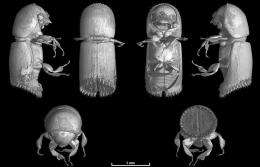
Beetle found in amber

(PhysOrg.com) -- A study led by University of New South Wales scientists has confirmed the discovery of Australia's most northerly fossil site - deposits of the precious mineral amber that contain a treasure trove of trapped animal and plant remains and even bubbles of air from millions of years ago.

The was found during a hazardous expedition last September to remote beaches on eastern Cape York, in far north Queensland, where the researchers braved crocodiles and sharks to find the source of amber pieces first seen washed up on nearby beaches in 2003 by alert beachcombers Beth Norris and Dale Wicks.

The amber itself is of many colours, from greens, reds and yellows to an almost psychedelic blue, says lead investigator Dr Suzanne Hand, of the UNSW School of Biological, Earth and Environmental Sciences (BEES). Its age is still uncertain but it has formed over millions of years from what was once tree resin in ancient rainforests.

"More importantly, many of the pieces we've looked at have inclusions of beautifully preserved plant and animal remains that were trapped in the resin before it hardened," Dr Hand says.

"There's a strange new species of beetle that looks like something from a science-fiction movie, a millipede, two species of ants, butterflies, spiders, many different kinds of flies, wasps, pseudo-scorpions, termites and even a tuft of hair from what I suspect is an ancient marsupial.

"This is a fabulous find. Not only are these are the most significant amounts of amber ever found in Australia but they occur where Australia and were once joined by a land bridge and until now we had almost no information about what was living there at the time. Now we can study some of the actual animals."

Team members have taken more than 100 opaque pieces of the Cape York amber to Grenoble for analysis at the European Synchrotron Radiation Facility. "We knew they had inclusions but we were amazed at the variety of things that emerged on the screen," says Hand. The facility was able to use those scanned images to make almost perfect three-dimensional giant models of some of the creatures, including the strange beetle and a prehistoric spider.

Explore further: Actor Johnny Depp immortalized in ancient fossil find

Related Stories

Oldest known spider's web found in amber

Nov 02, 2009

(PhysOrg.com) -- Pieces of amber containing parts of a spider's web have been found in East Sussex and dated back to the Cretaceous period 140 million years ago, which makes it the oldest spider's web known.

Amber reveals ecology of 30 million year old spiders

Mar 06, 2006

Scientists at The University of Manchester and the Manchester Metropolitan University have carried out the first comparative scientific study of ancient spiders trapped in amber more than 30 millions years ago.

Unexpected amber find rewrites botanical history

Oct 02, 2009

(PhysOrg.com) -- An unexpected discovery made by Macquarie University PhD student Sargent Bray about the origin and nature of chemical compounds contained in ancient amber has changed our understanding of ...

The secret jungles of ancient France

Jul 16, 2009

(PhysOrg.com) -- Ah, Paris. Land of the Eiffel Tower, delicious French bread and... tropical rainforests? Sacrebleu! It seems unlikely, but scientists have discovered evidence that France may have been a hot, wet tropical ...

Recommended for you

The eloquence of the otoliths

May 16, 2013

Fish fossils that are about 23 million years old give unprecedented insight into the evolutionary history of the gobioid order, one of the most species-rich groups among the modern bony fishes.

Light cast on lifestyle and diet of first New Zealanders

May 16, 2013

(Phys.org) —A University of Otago-led multidisciplinary team of scientists have shed new light on the diet, lifestyles and movements of the first New Zealanders by analysing isotopes from their bones and teeth.

mtDNA study shows Minoans came from Europe not Africa

May 15, 2013

(Phys.org) —A new study conducted by a team of American and Greek researchers has found that the people of the ancient Minoan civilization living on the island of Crete most likely came from Europe. In ...

User comments : 4

Adjust slider to filter visible comments by rank

Display comments: newest first

RobertKarlStonjek
not rated yet Jun 18, 2010
Looks like an ancient nostril beetle...
Wayfarer
not rated yet Jun 18, 2010
Fascinated by a "beetle" with only four legs. More
pictures please!
TJ_alberta
not rated yet Jun 18, 2010
Wayfarer: yes -- good observation! more photos are in order. Do the front legs look like two pair at the same position (segment?) And there may be some vestigial limbs anterior to those (like a double chin).
Wayfarer
not rated yet Jun 18, 2010
TJ alberta, what we need is electron close ups,the old eyes aint what they used to be!

More news stories

Alaska volcano shoots ash 15,000 feet into the air

(AP)—One of Alaska's most restless volcanoes has shot an ash cloud 15,000 feet into the air in an ongoing eruption that has drawn attention from a nearby community but isn't expected to threaten air traffic.

US seizes Bitcoin operator accounts

US authorities seized the accounts of a Bitcoin digital currency exchange operator, claiming it was functioning as an "unlicensed money service business," court documents showed Friday.

Chinese, Indian airlines face EU pollution fines

Eight Chinese and two Indian airlines face fines of up to several million euros for not paying for their greenhouse gas emissions during flights within the bloc, the European Commission said on Friday.