Gold nanoparticles create visible-light catalysis in nanowires
Jun 15, 2010
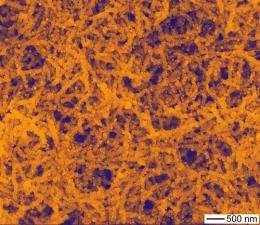
The gold-coated silver chloride nanowires at the microscopic level.

(PhysOrg.com) -- A scientist at the Argonne National Laboratory has created visible-light catalysis, using silver chloride nanowires decorated with gold nanoparticles, that may decompose organic molecules in polluted water.

"Silver nanowires have been extensively studied and used for a variety of applications, including transparent conductive electrodes for and optoelectronic devices," said nanoscientist Yugang Sun of Argonne's Center for . "By chemically converting them into semiconducting silver chloride nanowires, followed by adding gold nanoparticles, we have created nanowires with a completely new set of properties that are significantly different from the original nanowires."

Traditional silver chloride photocatalytic properties are restricted to ultraviolet and blue light wavelengths, but with the addition of the gold nanoparticles, they become photocatalytic in visible light. The visible light excites the electrons in the gold nanoparticles and initiates reactions that culminate in charge separation on the silver chloride nanowires. Tests have already shown that gold-decorated nanowires can decompose organic molecules such as methylene blue.

"If you were to create a film of gold-decorated nanowires and allow polluted water to flow through it, the may be destroyed with visible from conventional fluorescent light bulbs or the sun," Sun said.

Sun started with traditional silver nanowires that were oxidized with iron chloride to create silver chloride nanowires. A sequential reaction with sodium tetrachloroaurate deposited the on the wires.

Sun said it is possible to use a similar mechanism to deposit other metals such as palladium and platinum onto the silver chloride nanowires and create new properties, such as the ability to catalyze the splitting of water into hydrogen with sunlight.

A paper on this research was published in the Journal of Physical Chemistry C.

Explore further: Tailoring optical processors: Arranging nanoparticles in geometric patterns allows for control of light with light

More information: Journal paper: pubs.acs.org/doi/abs/10.1021/jp9115645

Related Stories

Copper Nanowires Enable Bendable Displays, Solar Cells

Jun 01, 2010

(PhysOrg.com) -- A team of Duke University chemists has perfected a simple way to make tiny copper nanowires in quantity. The cheap conductors are small enough to be transparent, making them ideal for thin-film ...

Low-Temperature Growth and Properties of ZnO Nanowires

Jun 01, 2004

Xuan Wang et al. from Peking University, China report in the last issue of Applied Physics Letters about ZnO nanowires grown through evaporation of zinc powders under a low temperature of 400 C. Being about 10 ...

Danish nanowires have great potential

Nov 02, 2009

Danish nanophysicists have developed a new method for manufacturing the cornerstone of nanotechnology research - nanowires. The discovery has great potential for the development of nanoelectronics and highly ...

Through the Wire: A New Nanocatalyst Synthesis Technique

Mar 16, 2009

(PhysOrg.com) -- Materials containing bimetallic nanoparticles are attractive in vast technological fields because of their unique catalytic, electronic, and magnetic properties. One of the most promising ...

Recommended for you

Engineers' nanoantennas improve infrared sensing

May 20, 2013

(Phys.org) —A team of University of Pennsylvania engineers has used a pattern of nanoantennas to develop a new way of turning infrared light into mechanical action, opening the door to more sensitive infrared ...

Stacking 2-D materials produces surprising results

May 16, 2013

(Phys.org) —Graphene has dazzled scientists, ever since its discovery more than a decade ago, with its unequalled electronic properties, its strength and its light weight. But one long-sought goal has proved ...

User comments : 0

More news stories

How gold nanoparticles can help fight ovarian cancer

Positively charged gold nanoparticles are usually toxic to cells, but cancer cells somehow manage to avoid nanoparticle toxicity. Mayo Clinic researchers found out why, and determined how to make the nanoparticles effective ...

Radioactive nanoparticles target cancer cells

Cancers of all types become most deadly when they metastasize and spread tumors throughout the body. Once cancer has reached this stage, it becomes very difficult for doctors to locate and treat the numerous tumors that can ...

Encouraging signs for bee biodiversity

Declines in the biodiversity of pollinating insects and wild plants have slowed in recent years, according to a new study. Researchers led by the University of Leeds and the Naturalis Biodiversity Centre in the Netherlands ...

If you can remember it, you can remember it wrong

(Medical Xpress)—Native peoples in regions where cameras are uncommon sometimes react with caution when their picture is taken. The fear that something must have been stolen from them to create the photo ...

B vitamins could delay dementia

(Medical Xpress)—Despite spending billions of dollars on research and development, drug companies have been unable to come up with effective treatments for dementia and Alzheimer's Disease (AD). Now, A. ...