Australia to sue Japan over whaling
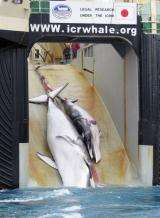
Australia said Friday it would begin legal action next week to stop Japan killing hundreds of whales a year in the name of scientific research, prompting immediate condemnation from Tokyo.
Officials said they would lodge documents with the International Court of Justice (ICJ) in The Hague "early next week", abandoning diplomacy after repeated threats to sue.
"We want to see an end to whales being killed in the name of science in the Southern Ocean," said Environment Protection Minister Peter Garrett.
"Today's announcement of legal action shows the government is taking steps to bring a permanent end to whaling in the Southern Ocean."
Japanese Fisheries Minister Hirotaka Akamatsu called the announcement "very disappointing", adding that Japan's "research" was approved under the rules of an international moratorium on commercial whaling.
Foreign Minister Stephen Smith said the government had been unable to find a diplomatic solution to the problem, despite protracted talks and debate within the International Whaling Commission (IWC).
"The Australian government has not taken this decision lightly," said Smith.
"But recent statements by whaling countries in the commission have provided Australia with little cause for hope that our serious commitment to conservation of the world's whales will be reflected in any potential IWC compromise agreement," he added.
Smith denied the action would affect relations with Japan, one of Australia's top two export markets, describing it as "a disagreement in one element of a relationship that is deep, broad and multi-dimensional".
New Zealand said it was also considering a case against Japan in the ICJ, with Foreign Minister Murray McCully promising a decision "in the next few weeks".
"The government has always said that action in the ICJ remains an option for New Zealand if the diplomatic process fails," McCully said.
Both countries have consistently opposed Japan's whaling, which it carries out under a loophole in the 1986 international moratorium that allows "lethal research".
Canberra hardened its rhetoric in recent months, warning Japan that diplomacy would "come to an end this year" as it lodged a bold plan to phase out the controversial hunts with the IWC.
Tokyo has defended the legality of its programme and described as "extremely regrettable" Australia's bid to abolish so-called "scientific whaling" and stop harpooning in the Southern Ocean within five years.
After months of wrangling, the IWC last month adopted a compromise proposal that would allow Japan, Iceland and Norway to hunt the ocean giants openly if they agree to reduce their catch "significantly" over 10 years.
Australia attacked the compromise, under which Japan's Antarctic catch would go down to 410 whales next season -- from about 500 this year -- and then 205 in the 2015-2016 season.
Dramatic confrontations between militant anti-whalers and harpooners have stoked the tensions, with the Sea Shepherd Conservation Society harassing Japan's fleet on the high seas.
This week New Zealand activist Pete Bethune went on trial in Tokyo for boarding a whaling ship in retaliation for a collision that sunk Sea Shepherd's high-tech Ady Gil powerboat in January.
Bethune, 45, was detained by the whalers and taken back to Japan, where he was formally arrested by the Japanese Coast Guard and charged with obstructing business, trespass, property destruction, weapons violations and assault.
He pleaded guilty to all but the assault charge, which relates to his firing a rancid butter stink-bomb during a February 11 clash with whalers. Bethune faces up to 15 years in prison and a verdict is expected in June.
Japan and New Zealand are yet to release the findings of their own inquiries into the clash.
The IWC is next due to meet in Morocco in June.
(c) 2010 AFP


