Nanocapsule delivers radiotherapy
May 26, 2010 by Pete Wilton
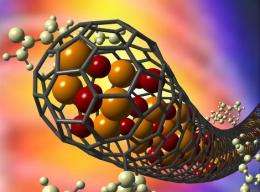
Image: Nanocapsules by Gerard Tobias

(PhysOrg.com) -- 'Hot' nanocapsules can deliver targeted radiotherapy to individual organs, new research has shown.

A team, including Ben Davis and Malcolm Green of Oxford University’s Department of Chemistry, report in Nature Materials how they created a ‘cage’ out of a single-walled carbon nanotube and then filled this tube with molten radioactive metal halide salts.

Once the cage, and its cargo of salts, cooled the ends of the tube sealed to create a tiny radioactive nanocapsule with a ‘sugary’ outer surface that helps to improve its compatibility inside the body.

Using this method the team were able to create nanocapsules that could deliver a highly concentrated dose of radiation (800% ionizing dose per gram) of the kind needed for radiotherapy. They then used mice to test how these radioactive nanocapsules would be taken up by the body.

They found that the nanocapsules accumulated in the but not in the thyroid, stomach, or bladder as occurred with ‘free’ doses of radioactive salts introduced without first being encapsulated. Even after a week in the body the nanocapsules remained stable without any significant leaking of radiation beyond the lung.

Whilst a lot of further work would be needed to create a treatment for humans, it’s the first time that researchers have shown how such a nanocapsule system for targeted might be made to work inside the body.

As the accompanying News & Views article notes this demonstration shows that: ‘radiosurgery at the nanoscale, from within the human body may have moved a step closer from science fiction to clinical practice.’

Explore further: Single-cell transfection tool enables added control for biological studies

add to favorites email to friend print save as pdf

Related Stories

Nanotubes Enable New Approach to Cancer Radiotherapy

Aug 22, 2007

Radioactive elements, or radionuclides, are well-established anticancer agents whose main limitation is that they kill healthy cells almost as easily as they do tumors. But because nanoparticles can be targeted to tumors, ...

ASTRO releases SBRT for lung cancer report

Apr 28, 2010

The American Society for Radiation Oncology (ASTRO) has released its Emerging Technology Committee's report evaluating the use of stereotactic body radiotherapy (SBRT) in lung cancer treatment.

Radioactive scorpion venom for fighting cancer

Jun 27, 2006

Health physicists are establishing safe procedures for a promising experimental brain-cancer therapy which uses a radioactive version of a protein found in scorpion venom. For many, this will conjure images of Spiderman's ...

NPL unveils new equipment to make cancer treatment safer

Nov 14, 2008

A new piece of medical technology unveiled at the National Physical Laboratory (NPL) today will help improve the success rates of radiotherapy cancer treatments. The new clinical electron linear accelerator (linac) will help ...

Recommended for you

Radioactive nanoparticles target cancer cells

May 21, 2013

Cancers of all types become most deadly when they metastasize and spread tumors throughout the body. Once cancer has reached this stage, it becomes very difficult for doctors to locate and treat the numerous tumors that can ...

How gold nanoparticles can help fight ovarian cancer

May 21, 2013

Positively charged gold nanoparticles are usually toxic to cells, but cancer cells somehow manage to avoid nanoparticle toxicity. Mayo Clinic researchers found out why, and determined how to make the nanoparticles effective ...

Advance in nanotech gene sequencing technique

May 20, 2013

(Phys.org) —The allure of personalized medicine has made new, more efficient ways of sequencing genes a top research priority. One promising technique involves reading DNA bases using changes in electrical ...

User comments : 0

More news stories

Forecast for Titan: Wild weather could be ahead

(Phys.org) —Saturn's moon Titan might be in for some wild weather as it heads into its spring and summer, if two new models are correct. Scientists think that as the seasons change in Titan's northern hemisphere, ...