Spacecraft Reveals Small Solar Events Have Large Scale Effects
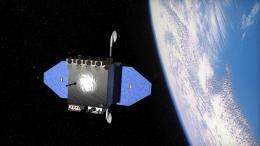
(PhysOrg.com) -- NASA's Solar Dynamics Observatory, or SDO, has allowed scientists for the first time to comprehensively view the dynamic nature of storms on the sun. Solar storms have been recognized as a cause of technological problems on Earth since the invention of the telegraph in the 19th century.
The Atmospheric Imaging Assembly (AIA), one of three instruments aboard SDO, allowed scientists to discover that even minor solar events are never truly small scale. Shortly after AIA opened its doors on March 30, scientists observed a large eruptive prominence on the sun's edge, followed by a filament eruption a third of the way across the star's disk from the eruption.
"Even small events restructure large regions of the solar surface," said Alan Title, AIA principal investigator at Lockheed Martin Advanced Technology Center in Palo Alto, Calif. "It's been possible to recognize the size of these regions because of the combination of spatial, temporal and area coverage provided by AIA."
The AIA instrument also has observed a number of very small flares that have generated magnetic instabilities and waves with clearly-observed effects over a substantial fraction of the solar surface. The instrument is capturing full-disk images in eight different temperature bands that span 10,000 to 36-million degrees Fahrenheit. This allows scientists to observe entire events that are very difficult to discern by looking in a single temperature band, at a slower rate, or over a more limited field of view.
The data from SDO is providing a torrent of new information and spectacular images to be studied and interpreted. Using AIA's high-resolution and nearly continuous full-disk images of the sun, scientists have a better understanding of how even small events on our nearest star can significantly impact technological infrastructure on Earth.
Solar storms produce disturbances in electromagnetic fields that can induce large currents in wires, disrupting power lines and causing widespread blackouts. The storms can interfere with global positioning systems, cable television, and communications between ground controllers and satellites and airplane pilots flying near Earth's poles. Radio noise from solar storms also can disrupt cell phone service.
Launched in Feb. 2010, the spacecraft's commissioning May 14 confirmed all three of its instruments successfully passed an on-orbit checkout, were calibrated and are collecting science data.
"We're already at five million images and counting," said Dean Pesnell, the SDO project scientist at NASA's Goddard Space Flight Center in Greenbelt, Md. "With data and images pouring in from SDO, solar scientists are poised to make discoveries that will rewrite the books on how changes in solar activity have a direct effect on Earth. The observatory is working great, and it's just going to get better."
Provided by JPL/NASA


