Solar Dynamics Observatory Begins its Five-Year Mission of Discovery
May 19, 2010
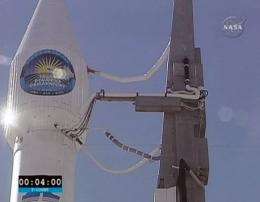
This NASA TV video grab shows the Solar Dynamics Observatory (SDO) and its Atlas V rocket at Cape Canaveral, Florida. An Atlas V rocket carrying a US solar observatory into space blasted off from Kennedy Space Center in Florida.

NASA's Solar Dynamics Observatory (SDO) passed a major milestone on May 14, when it completed its post-launch check out and officially began its five-year science mission to study the sun.

During a commissioning ceremony held in the SDO Mission Operations Center at Goddard Space Flight Center in Greenbelt, Md., mission engineers declared that the spacecraft has transitioned fully from engineering operations into science operations. All three of the instruments aboard have successfully passed their on-orbit checkout, have been calibrated, and are now taking science data.

Outgoing SDO Project Manager Liz Citrin led the overall design, engineering, and construction of the SDO mission. "This team has worked together for at least six years, and we're happy because everything has gone so well," said Citrin.

"Now that SDO has begun mission operations, we're doing what the mission was designed to do," said Patrick Crouse, project manager of Space Science Mission Operations at Goddard. "Our job now is to execute the requirements on a daily basis, to fly, operate, and do the day-to-day commanding, to collect the data, and to distribute it to the scientists."

Since SDO's launch on February 11, the spacecraft has maneuvered into an orbit located on the outer edges of Earth's . The satellite's inclined geosynchronous orbit, achieved March 16, allows for nearly continuous, high data-rate contact with a dedicated ground station near Las Cruces, New Mexico. NASA has set up a new facility that includes a pair of dedicated Ka-band radio antennas. SDO's geosynchronous orbit will keep the observatory in constant view of the two 18-meter dishes for the duration of the five-year mission.

SDO is the first mission of NASA's Living with a Star Program and a major component of the Heliophysics System Observatory. This fleet of widely deployed solar, heliospheric, and geospace satellites works together to understand the processes at work throughout our space environment. The goal of LWS is to develop the scientific understanding necessary to address those aspects of the sun-earth system that directly affect our lives and society.

Data and images are already beginning to pour in from SDO. "We're at 4 million images already, and counting," said SDO Project Scientist Dean Pesnell. "The end of commissioning means that we’re no longer verifying that the satellite works. The instruments are turned on and checked out. The data paths are carrying the data to the science teams. The observatory is working great, and it's just going to get better."

Explore further: Dark, massive asteroid to fly by Earth on May 31

More information: www.nasa.gov/sdo

add to favorites email to friend print save as pdf

Related Stories

NASA Successfully Launches a New Eye on the Sun

Feb 11, 2010

(PhysOrg.com) -- NASA's Solar Dynamics Observatory, or SDO, lifted off Thursday from Cape Canaveral Air Force Station's Launch Complex 41 on a first-of-a-kind mission to reveal the sun's inner workings in ...

Solar Dynamics Observatory Set to Launch Feb. 9

Feb 02, 2010

(PhysOrg.com) -- The Solar Dynamics Observatory, or SDO, is set to launch from Florida no earlier than 10:30 a.m. EST on Feb. 9, on an unprecedented mission to study the sun and its dynamic behavior. Onboard ...

Recommended for you

Dark, massive asteroid to fly by Earth on May 31

11 hours ago

It's 1.7 miles long. Its surface is covered in a sticky black substance similar to the gunk at the bottom of a barbecue. If it impacted Earth it would probably result in global extinction. Good thing it is ...

Research team explains 'Lazarus' comets

14 hours ago

Astronomers from the University of Antioquia have discovered a graveyard of comets. These once-dormant comets, dubbed by astronomers as "The Lazarus comets," are now rejuvenated.

NASA ships sensors for seafaring satellite to France

15 hours ago

(Phys.org) —Three NASA-built instruments that are integral components of the next in a series of U.S./European ocean altimetry satellites have arrived in France for integration with their spacecraft in ...

Trip into space with DiCaprio costs $1.55m

15 hours ago

Leonardo DiCaprio is going to get closer to stars of a different kind as he heads into space aboard the Virgin Galactic, and a well-heeled bidder at the Cannes Film Festival has paid 1.2 million euros (1.5 million) to be ...

User comments : 0

More news stories

Galaxies fed by funnels of fuel

(Phys.org) —Computer simulations of galaxies growing over billions of years have revealed a likely scenario for how they feed: a cosmic version of swirly straws.

Dark, massive asteroid to fly by Earth on May 31

It's 1.7 miles long. Its surface is covered in a sticky black substance similar to the gunk at the bottom of a barbecue. If it impacted Earth it would probably result in global extinction. Good thing it is ...

Source of life running out: water scientists

The majority of people on Earth people will face severe water shortages within a generation or two if pollution and waste continues unabated, scientists warned at a conference in Bonn Friday.

Google eyes emerging markets networks

Google has become deeply involved in a series of projects to build and operate wireless networks in emerging markets including sub-Saharan Africa and Southeast Asia, a report said Friday.