'Molecular glass fibers'
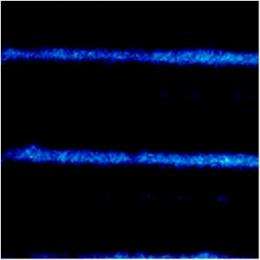
Dutch nanotechnologists from the MESA+ research institute of the University of Twente have discovered that the photosynthesis system of bacteria can be used to transport light over relatively long distances. They have developed a type of 'molecular glass fibre', a thousand times thinner than a human hair. The results of their research are published in the April edition of the leading journal Nano Letters.
All plants and some bacteria use photosynthesis to store energy from the sun. Researchers from the MESA+ Institute for Nanotechnology of the University of Twente have now discovered how parts of the photosynthesis system of bacteria can be used to transport light. In their experiments the researchers used isolated proteins from the so-called Light Harvesting Complex (LHC). These proteins transport the sunlight in the cells of plants and bacteria to a place in the cell where the solar energy is stored. The researchers built a type of 'molecular glass fibre' from the LHC proteins that is a thousand times thinner than a human hair.
In the experiment the researchers fastened the proteins onto a fixed background. They positioned them in a line, and in this way formed a thread. They then shone laser light to one point in the thread, and observed where the light went to. The line with the LHC proteins did not only transport the light, but transported it over much longer distances than the researchers had initially expected. Distances of around 50 nanometres are normally bridged in the bacteria from which the LHC proteins were isolated. In the researchers' experiments the light covered distances at least thirty times greater.
According to Cees Otto, one of the researchers involved, we can learn a lot from nature in experiments such as this. "The LHC proteins are the building blocks that nature gives us, and using then we can learn more about natural processes such as the transport of light in photosynthesis. When we understand how nature works, we can then imitate it. In time we will be able to use this principle in, for example, solar panels."
More information: The article 'Long-Range Energy Propagation in Nanometre Arrays of Light Harvesting Antenna Complexes' by Maryana Escalante, Aufried Lenferink, Yiping Zhao, Niels Tas, Jurriaan Huskens, Neil Hunter, Vinod Subramaniam and Cees Otto was published in the April edition of the scientific journal Nano Letters.
Provided by University of Twente


