Satellite takes a space-eye view of Arctic ice
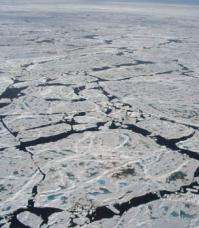
(PhysOrg.com) -- More than 700 kilometres above Earth, a recently launched satellite is being readied to provide University of Alberta researchers with a new set of eyes for monitoring ice thickness across the Arctic.
Martin Sharp and Christian Haas, researchers in the U of A's Department of Earth and Atmospheric Sciences, will play lead roles making sure CryoSat 2, launched earlier this month by the European Space Agency, provides accurate readings.
Haas will compare CryoSat's calculations of sea-ice volume with data he's collected with electronic monitoring equipment over the years on numerous low altitude flights. Last spring, Haas zigzagged his way across the Arctic, just 60 metres above the sea ice, covering the vast area between Greenland and Alaska. Haas will update his own research next month with a series of helicopter flights over the ice.
Haas says Cryosat 2's readings will be validated over the next six months and expects that its results will go online this fall.
"The satellite will provide updated Arctic-wide data once every month," said Haas. "The satellite will compliment the research that I and others will continue with and the result will be a total picture of seasonal variations of the ice."
Haas explains this orbiting technology has a distinct advantage over Arctic research done on foot or from low flying aircraft, because it's weather proof.
"CryoSat uses radar telemetry which can see through any kind of weather and cloud cover," said Haas.
CryoSat 2 isn't the first satellite to measure ice thickness at both poles. Last fall, an American satellite called ICESAT suddenly stopped working after nearly six years in orbit. In 2005, the European Space Agency launched CryoSat 1, but that mission ended badly with a launch failure a couple of minutes after blast off.
Haas says things are so far, so good, with this European Space Agency mission. The life expectancy of CryoSat 2 is three to five years.
While Haas focuses his work on sea ice, Sharp will work to validate the satellite's reading of land-based ice sheets. Sharp says that while previous radar telemetry surveys of Arctic land masses focused on large land forms like Greenland, CryoSat 2 will include data from smaller ice formations covering islands in the Canadian Arctic.
"We have evidence that in the last decade the ice-mass loss in the Canadian Arctic has gone up from 15 cubic kilometres a year to close to 100," said Sharp. "As far as we can tell most of this is from surface melt, but we couldn't tell that from previous satellite surveys."
The new satellite will provide the detailed measurements of ice sheets covering rough terrain, which Sharp says is especially important along the steep edges of ice sheets where the highest rate of melting occurs.
To validate the satellite's coverage of ice sheets on land, members of Sharp's team will stand on Devon Island, located in Baffin Bay, Nunavut, and synchronize their watches with a survey aircraft fly-by and the CryoSat 2 satellite out on the edge of space. Readings from all three sources will be compared. "We're going to try and get as close to a real time as we can with all the measurements."
Looking to the future of polar research, Sharp already has concerns about the continuity of satellite coverage when CryoSat's lifecycle comes to an end.
"Do we keep putting satellites up or do we allow big gaps in our coverage of the Arctic," said Sharp. "Those are the key, high-level decisions that space agencies have to make."
Provided by University of Alberta


