Little melamine appears in eggs from chickens on highly contaminated feed
Apr 14, 2010
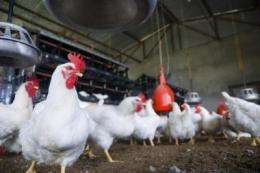
Chickens that eat high levels of melamine in their feed still produce eggs that contain low levels of the potentially toxic contaminant.

Eggs from chickens that consumed extremely high levels of melamine in their feed still did not contain levels of the potentially toxic contaminant that exceeded U. S. Food and Drug Administration (FDA) limits. That was the conclusion of the first study to check on the effects of melamine-contaminated feed in laying hens. It appears in ACS' Journal of Agricultural and Food Chemistry.

Liying Zhang and colleagues note that melamine, which is used to make certain plastics, triggered a public health controversy in 2008 because certain food manufacturers in China illegally added it to milk powder to distort the protein content. Authorities have since found excessive levels of melamine in eggs from eating feed contaminated with the substance. However, scientists did not know how much melamine might accumulate in eggs from this process, until now.

In an effort to establish a scientific basis for determining the risk, Zhang's group gave melamine-contaminated feed to egg-laying hens and found that increasing amounts of the chemical in feed resulted in increasing amounts in the eggs. However, none of the melamine concentrations in the eggs exceeded the FDA's maximum allowable level — 2.5 parts per million (ppm) in foods. The highest levels of melamine in the feed, about 100 ppm, resulted in egg contamination levels of about 1.45 ppm. The scientists suggest that melamine contamination levels in feed that fall below 100 ppm would not result in potential hazards for food safety.

Explore further: RNA capable of catalyzing electron transfer on early earth with iron's help, study says

More information: "Deposition of Melamine in Eggs from Laying Hens Exposed to Melamine Contaminated Feed", Journal of Agricultural and Food Chemistry.

add to favorites email to friend print save as pdf

Related Stories

Advance in detecting melamine-adulterated food

May 13, 2009

Researchers in Indiana are reporting an advance toward faster, more sensitive tests for detecting melamine, the substance that killed at least 6 children and sickened 300,000 children in China who drank milk ...

More Chinese wheat gluten is recalled

Apr 04, 2007

A U.S. pharmaceutical and nutritional chemicals company has recalled all possibly contaminated wheat gluten it has imported from a Chinese supplier.

Research leads to new technology to protect human health

Jul 21, 2009

Larry Wackett and Michael Sadowsky, members of the University of Minnesota's BioTechnology Institute, developed an enzyme that is used in Bioo Scientific's new MaxDiscovery™ Melamine Test kit, which simplifies the detection ...

Recommended for you

Attacking MRSA with metals from antibacterial clays

May 17, 2013

In the race to protect society from infectious microbes, the bugs are outrunning us. The need for new therapeutic agents is acute, given the emergence of novel pathogens as well as old foes bearing heightened antibiotic resistance.

Keeping fruit, vegetables and cut flowers fresh longer

May 15, 2013

New technology offers the promise of reducing billions of dollars of losses that occur each year from the silent, invisible killer of fruits, vegetables and cut flowers—a gas whose effects are familiar to everyone who has ...

Why don't beetles freeze in the winter?

May 14, 2013

For 37 years, Queen's University Biochemistry professor Peter Davies has been unraveling the mystery of why some organisms including insects and fish don't freeze in the winter. His research into insect antifreeze protein ...

The molecular basis of strawberry aroma

May 13, 2013

You know that summer is here when juicy red strawberries start to appear on the shelves. In Germany, this seasonal fruit has never been more popular: on average 3.5 kilos per head were consumed in 2012—a ...

A new dimension for 3-D protein structures

May 13, 2013

(Phys.org) —3D structures of biological molecules like proteins directly affect the way they behave in our bodies. EPFL scientists have developed a new infrared-UV laser method to more accurately determine ...

User comments : 0

More news stories

Beautiful 'flowers' self-assemble in a beaker

By simply manipulating chemical gradients in a beaker of fluid, materials scientists at Harvard have found that they can control the growth behavior of crystals to create precisely tailored structures—such ...

Attacking MRSA with metals from antibacterial clays

In the race to protect society from infectious microbes, the bugs are outrunning us. The need for new therapeutic agents is acute, given the emergence of novel pathogens as well as old foes bearing heightened antibiotic resistance.

Making gold green: New non-toxic method for mining gold

Northwestern University scientists have struck gold in the laboratory. They have discovered an inexpensive and environmentally benign method that uses simple cornstarch—instead of cyanide—to isolate gold from raw materials ...

Advance in nanotech gene sequencing technique

(Phys.org) —The allure of personalized medicine has made new, more efficient ways of sequencing genes a top research priority. One promising technique involves reading DNA bases using changes in electrical ...

Finnish start-up launches smartphone to rival giants

A group of ex-Nokia employees who quit over the company's decision to abandon the planned MeeGo operating system in favour of Windows presented their own smartphone on Monday, hoping to rival the sector's ...