Helicopter Helps Test Radar for 2012 Mars Landing
Apr 13, 2010
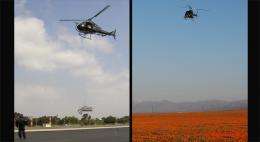
(Left) This image shows March 25, 2010, preparations for testing for a radar that will serve during the next landing on Mars. Image Credit: NASA/JPL-Caltech (Right) This image shows April 9, 2010, testing for a radar that will serve during the next landing on Mars. Image Credit: NASA/JPL-Caltech

(PhysOrg.com) -- This spring, engineers are testing a radar system that will serve during the next landing on Mars.

Recent tests included some near Lancaster, Calif., against a backdrop of blooming California poppy fields. In those tests, a helicopter carried an engineering test model of the landing radar for NASA's Mars Science Laboratory on prescribed descent paths. The descents at different angles and from different heights simulated paths associated with specific candidate sites for the mission.

The Mars Science Laboratory mission, managed by NASA's Jet Propulsion Laboratory, Pasadena, Calif., for , is in its assembly and testing phase, in advance of a launch in autumn 2011 and delivery of a rover named Curiosity to Mars in summer 2012.

During the final stage of the spacecraft's arrival at Mars in 2012, a rocket-powered descent stage will lower the rover on a tether directly to the ground. This rover is too big for the airbag-cushioned landing method used by NASA's Mars Pathfinder mission in 1997 and landings in 2004.

At Mars, a radar on the descent stage will track the spacecraft's decreasing distance from the surface. Additional helicopter-flown testing of the mission's will include checks of whether the suspended rover might confuse the radar about the speed of descent toward the ground.

Wolfe Air Aviation, of Pasadena, Calif., is providing the helicopter and flight services for the testing by a team of JPL engineers. The engineering test radar is affixed to a gimbal mounting at the front of the helicopter, which is more often used for aerial photography.

Explore further: NASA head views progress on asteroid lasso mission

add to favorites email to friend print save as pdf

Related Stories

San Diego Team Delivers Camera for Next Mars Rover

Apr 07, 2010

(PhysOrg.com) -- Malin Space Science Systems Inc., San Diego, has delivered the two cameras for the Mast Camera instrument that will be the science-imaging workhorse of NASA's Mars Science Laboratory rover, ...

Rocky Mesas of Nilosyrtis Mensae, Mars

May 06, 2008

Mesas in the Nilosyrtis Mensae region of Mars appear in enhanced color in this image from the High Resolution Imaging Science Experiment (HiRISE) camera on NASA's Mars Reconnaissance Orbiter (MRO).

Recommended for you

NASA head views progress on asteroid lasso mission

1 hour ago

Surrounded by engineers, NASA chief Charles Bolden inspected a prototype spacecraft engine that could power an audacious mission to lasso an asteroid and tow it closer to Earth for astronauts to explore.

Ecuador satellite collides with Russian space junk

1 hour ago

A small Ecuadoran satellite collided in orbit with the remains of a Russian rocket, but it is too soon to know how much damage it might have sustained, Quito's space agency said Thursday.

Forecast for Titan: Wild weather could be ahead

May 22, 2013

(Phys.org) —Saturn's moon Titan might be in for some wild weather as it heads into its spring and summer, if two new models are correct. Scientists think that as the seasons change in Titan's northern hemisphere, ...

SDO observes mid-level solar flare

May 22, 2013

UPDATE 16:30 p.m. EDT: The M7-class flare was also associated with a coronal mass ejection or CME, another solar phenomenon that can send billions of tons of particles into space. While this CME was not Ea ...

User comments : 0

More news stories

Hubble reveals the ring nebula's true shape

(Phys.org) —The Ring Nebula's distinctive shape makes it a popular illustration for astronomy books. But new observations by NASA's Hubble Space Telescope of the glowing gas shroud around an old, dying, ...

NASA head views progress on asteroid lasso mission

Surrounded by engineers, NASA chief Charles Bolden inspected a prototype spacecraft engine that could power an audacious mission to lasso an asteroid and tow it closer to Earth for astronauts to explore.

A hidden population of exotic neutron stars

(Phys.org) —Magnetars – the dense remains of dead stars that erupt sporadically with bursts of high-energy radiation - are some of the most extreme objects known in the Universe. A major campaign using ...