M81's 'Halo' Sheds Light on Galaxy Formation
Apr 13, 2010
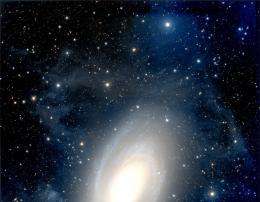
Visible light image of spiral galaxy M81 taken by Suprime-Cam.

(PhysOrg.com) -- Observations with Subaru Telescope's Prime Focus Camera (Suprime-Cam) have revealed an extended structure of the spiral galaxy Messier 81 (M81) that may hold a key to understanding the formation of galaxies. This structure could be M81's halo. Until now, ground-based telescopes have only observed individual stars in the haloes around the Milky Way and Andromeda Galaxies. Differences in M81's extended structure from the Milky Way's halo may point to variations in the formation histories of spiral galaxies.

M81 is one of the largest galaxies in the M81 Group, a group of 34 galaxies located toward the constellation Ursa Major. At 11.7 million light years from Earth, it is one of the closest groups to the Local group, the group of galaxies that includes our own Milky Way. Thanks to its proximity and similarity to the Milky Way, M81 provides an excellent laboratory for testing models.

The most prominent of these models predicts that galaxies are built up from the merging and accretion of many smaller galaxies that orbit within their gravitational sphere of influence. This chaotic, bottom-up growth leaves behind a of stars around massive spirals like the Milky Way. Do the findings about M81's extended structure, possibly its halo, support this view?

True to its promise as an effective tool for the study of , Subaru's telescope has provided data to address this question. The enormous light-gathering power of Subaru Telescopes's 8.2 meter primary mirror and the wide field-of-view of its Suprime-Cam enabled the telescope to provide evidence for a faint, extended structural component beyond M81's bright optical disk. It probed into space over one-hundred times darker than the night sky and imperceptible to the naked eye. The telescope spotted individual stars and gathered enough of them to identify M81's extended component and analyze its physical properties.

The results defy exact classification of the extended structure as a halo. Although the spatial distribution of its stars resembles the Milky Way's halo, M81's "halo" differs from the Milky Way's in other respects. Measurements of the total light from all of its stars and analysis of their colors point to estimates that M81's "halo" could be several times brighter and contain more processed materials, nearly twice as much mass in the form of metals (all elements heavier than helium), than the Milky Way's halo.

These differences prompt some fascinating questions. Do we need to expand our definition of a halo? Does this structure have a very different formation history than the Milky Way's halo? Did these differences arise because M81 cannibalized more or different kinds of small galaxies in the past than the did? Regardless of the answers to these queries, the results of this research contribute to the growing body of evidence that the outer structures of apparently similar galaxies are much more important and complex than astronomers have previously thought.

Explore further: Hubble reveals the ring nebula's true shape

Related Stories

Origins of the Milky Way

Mar 19, 2010

(PhysOrg.com) -- According to current astronomical models, the Milky Way and other large galaxies formed over billions of years in a process that involved interactions between smaller galaxies, and in particular ...

Old star is 'missing link' in galactic evolution

Mar 03, 2010

(PhysOrg.com) -- A newly discovered star outside the Milky Way has yielded important clues about the evolution of our galaxy. Located in the dwarf galaxy Sculptor some 280,000 light-years away, the star has ...

Hot, massive haloes found around most spiral galaxies

Dec 14, 2005

Astronomers using ESA's XMM-Newton observatory have found very hot gaseous haloes around a multitude of spiral galaxies similar to our Milky Way galaxy. These 'ghost-like' veils have been suspected for decades ...

Recommended for you

Hubble reveals the ring nebula's true shape

21 hours ago

(Phys.org) —The Ring Nebula's distinctive shape makes it a popular illustration for astronomy books. But new observations by NASA's Hubble Space Telescope of the glowing gas shroud around an old, dying, ...

A hidden population of exotic neutron stars

May 23, 2013

(Phys.org) —Magnetars – the dense remains of dead stars that erupt sporadically with bursts of high-energy radiation - are some of the most extreme objects known in the Universe. A major campaign using ...

User comments : 1

Adjust slider to filter visible comments by rank

Display comments: newest first

Bigbangcon
1 / 5 (2) Apr 14, 2010
"These differences prompt some fascinating questions. Do we need to expand our definition of a halo? Does this structure have a very different formation history than the Milky Way's halo? Did these differences arise because M81 cannibalized more or different kinds of small galaxies in the past than the Milky Way did?" These and many other questions - (if you are desperate you can add,is this the capricious "smile" of the invisible cats black matter/energy? etc. etc.)assume the incontrovertible truth of the Big Bang theology. So, if the Big Bang paradygm has nothing to do with these problems, then these will always be mysteries no matter how hard you try to fit them into it. Please try an exact opposite view of the origin, the evolution and the formation of galaxies at the link below and see if some answer to these questions can be found:
Ambartsumian, Arp and the Breeding Galaxies: http://redshift.v...MAL.pdf.

More news stories

Dark, massive asteroid to fly by Earth on May 31

It's 1.7 miles long. Its surface is covered in a sticky black substance similar to the gunk at the bottom of a barbecue. If it impacted Earth it would probably result in global extinction. Good thing it is ...

Source of life running out: water scientists

The majority of people on Earth people will face severe water shortages within a generation or two if pollution and waste continues unabated, scientists warned at a conference in Bonn Friday.

Storm chasers: born to be wild?

(HealthDay)—We've all seen them: the surfers who race to the beach when a hurricane hits, the guy who decides to ride out the storm in his overmatched boat, the tornado chasers who fearlessly steer their ...