Berkeley Lab Scientists Create 'Molecular Paper' (w/ Video)
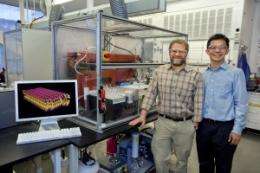
(PhysOrg.com) -- Berkeley Lab scientists have created "molecular paper," the largest two-dimensional polymer crystal self-assembled in water to date. This entirely new sheet material is made of peptoids, engineered polymers that can flex and fold like proteins while maintaining the robustness of synthetic materials.
Two-dimensional, “sheet-like” nanostructures are commonly employed in biological systems such as cell membranes, and their unique properties have inspired interest in materials such as graphene. Now, Berkeley Lab scientists have made the largest two-dimensional polymer crystal self-assembled in water to date. This entirely new material mirrors the structural complexity of biological systems with the durable architecture needed for membranes or integration into functional devices.
These self-assembling sheets are made of peptoids, engineered polymers that can flex and fold like proteins while maintaining the robustness of manmade materials. Each sheet is just two molecules thick yet hundreds of square micrometers in area—akin to ‘molecular paper’ large enough to be visible to the naked eye. What’s more, unlike a typical polymer, each building block in a peptoid nanosheet is encoded with structural ‘marching orders’—suggesting its properties can be precisely tailored to an application. For example, these nanosheets could be used to control the flow of molecules, or serve as a platform for chemical and biological detection.
These fluorescence microscope images show free-floating peptoid nanosheets in liquid. Each peptoid sheet is just two molecules thick yet up to hundreds of square micrometers in area—a ‘molecular paper’ large enough to be visible to the naked eye.
“Our findings bridge the gap between natural biopolymers and their synthetic counterparts, which is a fundamental problem in nanoscience,” said Ronald Zuckermann, Director of the Biological Nanostructures Facility at the Molecular Foundry. “We can now translate fundamental sequence information from proteins to a non-natural polymer, which results in a robust synthetic nanomaterial with an atomically-defined structure.”
The building blocks for peptoid polymers are cheap, readily available and generate a high yield of product, providing a huge advantage over other synthesis techniques. Zuckermann, instrumental in developing the Foundry’s one-of-a-kind robotic synthesis capabilities, worked with his team of coauthors to form libraries of peptoid materials. After screening many candidates, the team landed upon the unique combination of polymer building blocks that spontaneously formed peptoid nanosheets in water.
Zuckermann and coauthor Christian Kisielowski reached another first by using the TEAM 0.5 microscope at the National Center for Electron Microscopy (NCEM) to observe individual polymer chains within the peptoid material, confirming the precise ordering of these chains into sheets and their unprecedented stability while being bombarded with electrons during imaging.
“The design of nature-inspired, functional polymers that can be assembled into membranes of large lateral dimensions marks a new chapter for materials synthesis with direct impact on Berkeley Lab’s strategically relevant initiatives such as the Helios project or Carbon Cycle 2.0,” said NCEM’s Kisielowski. “The scientific possibilities that come with this achievement challenge our imagination, and will also help move electron microscopy toward direct imaging of soft materials.”
“This new material is a remarkable example of molecular biomimicry on many levels, and will no doubt lead to many applications in device fabrication, nanoscale synthesis and imaging,” Zuckermann added.
This research is reported in a paper titled, “Free floating ultra-thin two-dimensional crystals from sequence-specific peptoid polymers,” appearing in the journal Nature Materials.
Provided by Lawrence Berkeley National Laboratory


