Smoke Alarms + Sprinklers + Closed Doors = Lives Saved in Dorm Fires
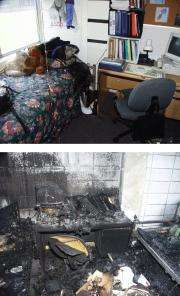
(PhysOrg.com) -- Experimenting on a university dormitory that was scheduled to be torn down, fire researchers from the National Institute of Standards and Technology have demonstrated that the correct combination of automatic fire sprinkler systems, smoke alarms and closed doors provided enough time and safe conditions for residents to escape safely and for firefighters to perform their job without undue hazard.
The study’s goal was to compare the hazard levels created by room fires in dormitory buildings with and without sprinklers in the room where the fire starts. Researchers used a dorm at the University of Arkansas in Fayetteville, Ark., that was scheduled to be replaced with a high-rise building.
Fires create many potentially fatal hazards, including high heat, loss of visibility and—what can be the most critical risk—toxic gases. In addition to monitoring thermal conditions and visibility, researchers also measured the oxygen, carbon monoxide and carbon dioxide levels to determine the tenability, that is, survival conditions, on the fire floor.
The five rooms used in the experiment were furnished as typical dorms are and included clothing, books and furniture. Smoke alarms were installed in the rooms and the corridors. The smoke alarms activated within 30 seconds of ignition of a trash container in a dorm room.
Experiments 1 and 2 were conducted with the dorm room door and windows closed and in both the experiments the corridor remained tenable, which would allow other students to exit safely past the room. Rooms for experiments 2 and 3 had automatic fire sprinklers installed. The automatic fire sprinklers activated within two minutes after ignition in both experiments. In the sprinklered experiments, tenability was maintained in the dorm room and the corridor.
Experiments 4 and 5 were conducted with the door of the dorm room open and no active sprinkler. In both experiments the tenability limits were exceeded in the dorm room and corridor.
“This study demonstrated the value of balanced fire safety design,” says NIST Fire Protection Engineer Dan Madrzykowski. “The results show the potential life safety benefits of smoke alarms, compartmentation and automatic fire sprinkler systems in college dormitories and similar occupancies.”
The experiments also demonstrated the importance of a closed door between the fire room and corridor in limiting the spread of smoke and gasses to other areas of the building.
The studied was performed as part of the U.S. Fire Administration’s initiative to improve fire safety in college housing and in collaboration with the University of Arkansas and the Fayetteville Fire Department.
Another series of experiment was conducted with fires starting in a day room area open to the dormitory corridor. The results of the two studies were published in “Impact of Sprinklers on the Fire Hazard in Dormitories: Sleeping Room Fire Experiments” (NIST Technical Note 1658, available at www.nist.gov/cgi-bin//get_pdf.cgi?pub_id=904640) and “Impact of Sprinklers on the Fire hazard in Dormitories: Day Room Fire Experiments” (NISTIR 7120, available at www.nist.gov/cgi-bin//get_pdf.cgi?pub_id=101409)
Provided by National Institute of Standards and Technology


