Compound screening for drug development made simpler
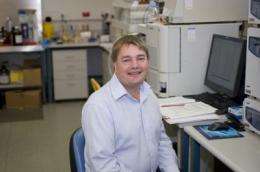
The identification of compounds that could be promising candidates for drug development has become easier following research by the Walter and Eliza Hall Institute's medicinal chemistry group.
Dr Jonathan Baell and Dr Georgina Holloway have developed a series of 'filters' that can be used to weed out those molecules likely to come up as false positives when screening a chemical library for compounds that could be useful in drug development.
High-throughput chemical screening (HTCS) seeks to identify chemical compounds that interact with a target protein and are therefore potential candidates for drug development. There can be from 30,000 to one million compounds in a screening library and thousands of compounds may be flagged as 'positive' for interaction with a protein of interest. These compounds then become the subject of time-consuming medicinal chemistry as scientists seek to refine them for entry into the drug development pipeline.
Dr Baell said about 10 per cent of compounds in any commercially available screening library might show up as false positives, potentially wasting hundreds of hours of scientists' time as they undertake labour-intensive medicinal chemistry to optimise these molecules.
"We're trying to remove molecules from the screening process that trick scientists into thinking they could be useful for being developed into drugs to treat disease but instead become a dead end," Dr Baell said.
To this end, Dr Baell and Dr Holloway analysed data from previous chemical screens and developed a way of clearly identifying those molecules likely to show up as false positives.
"These pan assay interference compounds, or PAINS as I like to call them, caused us some grief not so many years ago. For that reason, Georgina and I have taken some effort to identify these PAINS."
Dr Baell has made it possible for others to identify these troublesome molecules by developing 'filters', text files that can be incorporated into the software used to screen chemical libraries.
The filters were made publically available on 4 February through online publication in the Journal of Medicinal Chemistry.
High-throughput chemical screening has been used by large pharmaceutical companies for more than 20 years. In the past decade scientists at universities and research institutes and in small biotechnology companies have had increasing access to HTCS. "Many of them have spent vast amounts of time and money optimising and patenting molecules that were never going to amount to anything," Dr Baell said.
"We were in a position where we had all the data, we had the software, and we had the expertise to identify these molecules. Importantly, we also had the ability to publish our data.
"Pharmaceutical companies, which have used high-throughput chemical screening for many years, would know about many compounds that turn up as false positives. But they also operate in a competitive environment where publishing this data could compromise their competitive edge. For this particular situation, we didn't have such constraints."
Dr Baell said that within 48 hours of publishing the filters he was contacted by a number of pharmaceutical companies wishing to use them to assess their impact on their own high throughput screening libraries."
Provided by Walter and Eliza Hall Institute


