Superelastic iron alloy could be used for heart and brain surgery
Mar 23, 2010 by Lin Edwards report
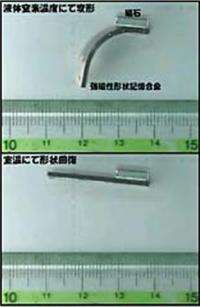
Shape memory alloys developed by the research group.

(PhysOrg.com) -- Scientists in Japan have designed an elastic iron-based shape metal alloy for use in applications as diverse as heart and brain surgery and buildings in earthquake-prone areas.

The researchers, from Tohoku University, said the ferrous polycrystalline shape memory alloy was as strong as high-strength industry alloys, but it is also superelastic, which means it can return to its original form when strain is removed and the material is heated, an important property of all shape memory alloys. The iron alloy even returns to its former shape when under almost twice the strain levels endured by current shape memory alloys. The alloy also exhibits changes in ductility and a large reversible change in magnetization during shape transitions.

The alloy’s is around double that of the shape memory alloy nickel-titanium, which means it can be formed into extremely thin wire. At present the nickel-titanium alloy is the only superelastic alloy available for practical use. Superelastic properties make a shape memory alloy ideal for delivering stents to parts of the body such as the heart since they can expand to a wider diameter when warmed by the body. Stents are tubes that are surgically implanted into blood vessels to prevent them collapsing.

One of the engineers, T. Omori, said stents are currently delivered to the heart using nickel titanium wire, but its diameter is too thick to allow it to be used in the brain. The new iron alloy could be made thin enough to be used for brain stents.

Omori said the elastic iron alloy may have other uses, such as in buildings in earthquake zones where a material that is both strong and flexible is needed. The buildings are deformed during the earthquake, but the iron alloy’s property of remembering and returning to its original form means the super-elastic alloy could return the building to its former shape. Other potential uses of superelastic include blast protection, noise reduction, and vibration isolation.

The paper was published in the journal Science last Friday.

Explore further: Femtosecond 'snapshots' reveal a dramatic bond tightening in photo-excited gold complexes

More information: Ferrous Polycrystalline Shape-Memory Alloy Showing Huge Superelasticity, Science 19 March 2010: Vol. 327. no. 5972, pp. 1488 - 1490; DOI:10.1126/science.1183169

Related Stories

Smart memory foam made smarter

Sep 24, 2009

Researchers from Northwestern University and Boise State University have figured out how to produce a less expensive shape-shifting "memory" foam, which could lead to more widespread applications of the material, such as ...

Precision control of movement in robots

May 16, 2008

A research team from the Department of Electricity and Electronics at the University of the Basque Country’s Faculty of Science and Technology in Leioa, Spain, led by Victor Etxebarria, is investigating the characteristics ...

An impossible alloy now possible

Feb 26, 2009

What has been impossible has now been shown to be possible - an alloy between two incompatible elements. The findings are being published in this week's edition of Proceedings of the National Academy of Science, USA.

Shape shifters: Researchers create new breed of antennas

Dec 01, 2009

(PhysOrg.com) -- Antennas aren't just for listening to the radio anymore. They're used in everything from cell phones to GPS devices. Research from North Carolina State University is revolutionizing the field ...

Design tool for materials with a memory

Jul 13, 2009

Shape memory alloys can "remember" a condition. If they are deformed, a temperature change can be enough to bring them back to their original shape. A simulation calculates the characteristics of these materials.

Recommended for you

Beautiful 'flowers' self-assemble in a beaker

May 16, 2013

By simply manipulating chemical gradients in a beaker of fluid, materials scientists at Harvard have found that they can control the growth behavior of crystals to create precisely tailored structures—such ...

User comments : 0

More news stories

Attacking MRSA with metals from antibacterial clays

In the race to protect society from infectious microbes, the bugs are outrunning us. The need for new therapeutic agents is acute, given the emergence of novel pathogens as well as old foes bearing heightened antibiotic resistance.

Beautiful 'flowers' self-assemble in a beaker

By simply manipulating chemical gradients in a beaker of fluid, materials scientists at Harvard have found that they can control the growth behavior of crystals to create precisely tailored structures—such ...

Making gold green: New non-toxic method for mining gold

Northwestern University scientists have struck gold in the laboratory. They have discovered an inexpensive and environmentally benign method that uses simple cornstarch—instead of cyanide—to isolate gold from raw materials ...

US seizes Bitcoin operator accounts

US authorities seized the accounts of a Bitcoin digital currency exchange operator, claiming it was functioning as an "unlicensed money service business," court documents showed Friday.

Chinese, Indian airlines face EU pollution fines

Eight Chinese and two Indian airlines face fines of up to several million euros for not paying for their greenhouse gas emissions during flights within the bloc, the European Commission said on Friday.

Alaska volcano shoots ash 15,000 feet into the air

(AP)—One of Alaska's most restless volcanoes has shot an ash cloud 15,000 feet into the air in an ongoing eruption that has drawn attention from a nearby community but isn't expected to threaten air traffic.