Biologists sequence Hydra genome
Mar 14, 2010
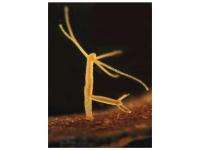
This photo of Hydra was taken in a Newport Beach, Calif., stream. The freshwater polyp has been a staple of biological research for 300 years. Credit: Peter Bryant / UC Irvine

UC Irvine researchers have played a leading role in the genome sequencing of Hydra, a freshwater polyp that has been a staple of biological research for 300 years.

In the March 14 online version of Nature, UCI biologists Robert Steele and Hans Bode, along with nine other UCI scientists and an international team of researchers, describe the of an organism that continues to advance research on regeneration, stem cells and patterning.

The team discovered Hydra to have about the same number of genes as humans, sharing many of the same ones. Surprisingly, they also found genes linked with Huntington's disease and with the beta-amyloid plaque formation seen in Alzheimer's disease - two areas in which UCI has traditionally strong research programs - suggesting the possible use of Hydra as a research model for these two diseases.

"Having the Hydra genome sequenced also enhances our ability to use it to learn more about the basic biology of , which are showing great promise for new treatments for a host of injuries and diseases," said Steele, associate professor and interim chair in biological chemistry.

Started in 2004, the Hydra project is the first effort in which UCI scientists have played a major role. The sequencing was carried out at the J. Craig Venter Institute and was funded by the National Human Research Institute.

Explore further: New formula invented for microscope viewing, substitutes for federally controlled drug

Provided by University of California - Irvine

not rated yet

Related Stories

Cancer: 'Primitive' gene discovered

Feb 11, 2010

To find the causes for cancer, biochemists and developmental biologists at the University of Innsbruck, Austria, retraced the function of an important human cancer gene 600 million years back in time. For ...

New genome sequencing targets announced

Jul 24, 2006

The U.S. National Human Genome Research Institute has announced several new sequencing targets, including the northern white-cheeked gibbon.

Body louse genome sequencing begins

Dec 09, 2005

Purdue University's Barry Pittendrigh and the University of Massachusetts' John Clark have been named to begin sequencing the complete body louse genome.

Horse genome sequence draft is issued

Feb 07, 2007

The U.S.-led Horse Genome Sequencing Project has issued its first draft, making it available to biomedical and veterinary scientists around the world.

Human chromosome 3 is sequenced

Apr 27, 2006

The sequencing of human chromosome 3 at Baylor College represents the final stage of a multi-year project to sequence the human genome.

Recommended for you

Turning up the heat on biofuels

May 16, 2013

(Phys.org) —The production of biofuels from lignocellulosic biomass would benefit on several levels if carried out at temperatures between 65 and 70 degrees Celsius. Researchers with the Energy Biosciences ...

Getting to the root of better crops

May 16, 2013

(Phys.org) —The more crop scientists know about how plant roots take up water and nutrients, the better able they will be to develop crop plants with roots that can cope with challenging soil and environmental ...

User comments : 0

More news stories

Tiger, tiger, not burning so bright

(Phys.org) —India's tigers are facing extinction owing to a collapse in the variety of their mating partners, according to new research carried out by scientists at Cardiff University.