Look at Mie! Team tests century-old calculations
Calculations are fine, but seeing is believing. That's the thought behind a new paper by Rice University students who decided to put to the test calculations made more than a century ago.
In 1908, the German physicist Gustav Mie came up with an elegant set of equations to describe the interaction of electromagnetic waves with a spherical metal particle. The theory has been a touchstone ever since for researchers seeking to quantify how nanoscale plasmonic particles scatter radiation.
"The Mie theory is used extensively whenever you deal with nanoparticles and their optical properties," said Alexei Tcherniak, a Rice graduate student and primary author of the new paper in the online edition of Nano Letters this month. "That's the foundation of every calculation."
Tcherniak and Stephan Link, a Rice assistant professor of chemistry and electrical and computer engineering, co-authored the paper with former graduate student Ji Won Ha and current Rice graduate students Liane Slaughter and Sergio Dominguez-Medina.
Better characterization of single nanoparticles is important to researchers pursuing microscopic optical sensors, subwavelength "super lenses," catalysis and photothermal cancer therapies that use nanoparticles.
"Since technology is moving toward single-particle detection, we wanted to see whether Mie's predictions would hold," Tcherniak said. "Average properties fall exactly on the predictions of Mie theory. But we show that individual particles deviate quite a bit." Particles that differ in size can return similar signals because they vary in shape and orientation on the substrate, with which they also interact. Mie's theory, developed for spherical particles in solution long before single-particle spectroscopy, did not consider these factors.
The project began as a sideline in the students' attempt to track single nanoparticles in solution. It became their primary focus when they realized the scope of the task, which involved analyzing five sets of gold particles ranging from 51 to 237 nanometers wide - the "biologically relevant" sizes, Tcherniak explained.
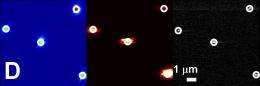
Each set of particles was photographed with a scanning electron microscope and then analyzed for its absorption and scattering properties via single-particle photothermal imaging and laser dark-field scattering.
It was tedious, they admitted.
"When you need to find a particle 50 nanometers across on a sample that is 5-by-5 millimeters, you're looking for a needle in a haystack," Tcherniak said. Slaughter and Dominguez-Medina nodded in agreement and recalled a summer of long days required to categorize several hundred particles -- enough "to get all those points on the graph."
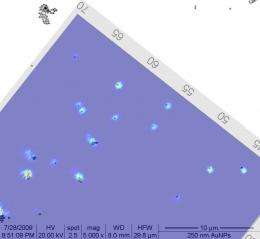
They used a couple of strategies to locate particles. One was to put micron-scale grid coordinates on the glass slide containing nanoparticle samples. "That let us know roughly where they were," Tcherniak said.
Another involved applying a bit of astronomy to their microscopy. They found themselves looking for "constellations" in the patterns of specks. "We started saying, 'Oh, that looks like a nose. Do we have a nose anywhere else?'" Slaughter said. "We were so tired; the names might not have been very good."
But their results are.
"Mie theory was around long before anyone knew about nanoparticles, so it's a neat thing to be able to test it," said Link of his students' work. "This is important because they really put together the building blocks that will enable scientists to look at more complex structures. This was not an easy job."
More information: View the paper at pubs.acs.org/doi/abs/10.1021/nl100199h
Provided by Rice University


