Quantum Walk in Laboratory
Mar 10, 2010
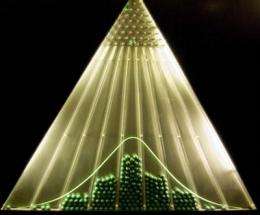
An example for a random walk is the Galton board, which is used to demonstrate binomial distribution to students. On this board, balls are dropped from the top and they repeatedly bounce either left or right in a random way as they hit pins stuck in the board. Credit: Antoine Taveneaux

A team of physicists headed by Christian Roos and Rainer Blatt from the Institute of Quantum Optics and Quantum Information of the Austrian Academy of Sciences realize a quantum walk in a quantum system with up to 23 steps. It is the first time that this quantum process using trapped ions is demonstrated in detail.

When a hiker comes to a junction s/he has to decide which way to take. All of these decisions, eventually, lead the hiker to the intended destination. When the hiker forgot the map, s/he has to make a decision randomly and gets to the destination with more or less detours. In science this is called a random walk and can regularly be encountered in mathematics and physics.

In 1827, for example, the Scottish botanist Robert Brown found out that pollen grains show irregular fluttering vibrations on water drops. This effect is caused by a random motion of - a phenomenon known in the scientific world as Brownian motion. Another example is the Galton board, which is used to demonstrate binomial distribution to students. On this board, balls are dropped from the top and they repeatedly bounce either left or right in a random way as they hit pins stuck in the board.

The Innsbruck scientists have now transferred this principle of random walk to quantum systems and stimulated an atom to take a quantum walk: "We trap a single atom in an electromagnetic and cool it to prepare it in the ground state," explains Christian Roos from the Institute of and (IQOQI). "We then create a quantum mechanical superposition of two inner states and send the atom on a walk." The two internal states correspond to the decision of the hiker to go left or right. However, unlike the hiker the atom does not really have to decide where to go; due to the superposition of the two states, both possibilities are presented at the same time.

"Depending on the internal state, we shift the ion to the right or to the left," explains Christian Roos. "Thereby, the motional and internal state of the ion are entangled." After each step the experimental physicists modify the of the inner states by a laser pulse and again shift the ion to the left or right. The physicists can repeat this randomly controlled process up to 23 times, while collecting data about how quantum walks work. By using a second ion, the scientists extend the experiment, giving the walking ion the additional possibility to stay instead of moving to the right or left.

The statistic analysis of these numerous steps confirms that quantum walks differ from classical (random) walks. While, for example, the balls of a Galton board move away from the starting point statistically very slowly, quantum particles spread much faster on their walk.

These experiments, which have also been realized in a similar way in Bonn, Munich and Erlangen with atoms, ions and photons, can be applied to studying natural phenomena. For example, researchers suspect that the energy transport in plants works more efficiently because of quantum walks than would be the case with classical walks. In addition, a regime of quantum walk is of importance for developing a quantum computer model, which could solve ubiquitous problems. For example, applying quantum walks in such a model would help in finding search quantum algorithms that outperform their classical counterparts as different directions could be chosen simultaneously.

Explore further: Hydrogen atoms under the magnifying glass

More information: Realization of a quantum walk with one and two trapped ions. Zähringer F, Kirchmair G, Gerritsma R, Solano E, Blatt R, Roos CF. Phys. Rev. Lett. 104, 100503 (2010). dx.doi.org/10.1103/PhysRevLett.104.100503

Provided by Austrian Academy of Sciences

4.5 /5 (11 votes)

Related Stories

Quantum simulation of a relativistic particle

Jan 06, 2010

(PhysOrg.com) -- Researchers of the Institute for Quantum Optics and Quantum Information (IQOQI) in Innsbruck, Austria used a calcium ion to simulate a relativistic quantum particle, demonstrating a phenomenon ...

Quantum measurements: Common sense is not enough

Jul 22, 2009

(PhysOrg.com) -- In comparison to classical physics, quantum physics predicts that the properties of a quantum mechanical system depend on the measurement context, i.e. whether or not other system measurements ...

Yale scientists bring quantum optics to a microchip

Sep 08, 2004

A report in the journal Nature describes the first experiment in which a single photon is coherently coupled to a single superconducting qubit (quantum bit or "artificial atom"). This represents a new paradigm in which ...

Ion trap quantum computing

May 12, 2009

(PhysOrg.com) -- “Right now, classical computers are faster than quantum computers,” René Stock tells PhysOrg.com. “The goal of quantum computing is to eventually speed up the time scale of solving certain import ...

Recommended for you

A quantum simulator for magnetic materials

1 hour ago

Physicists understand perfectly well why a fridge magnet sticks to certain metallic surfaces. But there are more exotic forms of magnetism whose properties remain unclear, despite decades of intense research. ...

Researchers forward quest for quantum computing

6 hours ago

Research teams from UW-Milwaukee and the University of York investigating the properties of ultra-thin films of new materials are helping bring quantum computing one step closer to reality.

Hydrogen atoms under the magnifying glass

May 22, 2013

To describe the microscopic properties of matter and its interaction with the external world, quantum mechanics uses wave functions, whose structure and time dependence is governed by the Schrödinger equation. ...

Making quantum encryption practical

May 21, 2013

One of the many promising applications of quantum mechanics in the information sciences is quantum key distribution (QKD), in which the counterintuitive behavior of quantum particles guarantees that no one can eavesdrop on ...

Lab sets a new record for creating heralded photons

May 20, 2013

(Phys.org) —Entanglement, by general consensus of physicists, is the weirdest part of quantum science. To say that two particles, A and B, are entangled means that they are actually two parts of an inseparable ...

Competition in the quantum world

May 20, 2013

Innsbruck physicists led by Rainer Blatt and Peter Zoller experimentally gained a deep insight into the nature of quantum mechanical phase transitions. They are the first scientists that simulated the competition ...

User comments : 0

More news stories

A quantum simulator for magnetic materials

Physicists understand perfectly well why a fridge magnet sticks to certain metallic surfaces. But there are more exotic forms of magnetism whose properties remain unclear, despite decades of intense research. ...

Engineers pioneer flat spray-on optical lens

A University of British Columbia engineer and a team of U.S. researchers have made a breakthrough utilizing spray-on technology that could revolutionize the way optical lenses are made and used.

Researchers forward quest for quantum computing

Research teams from UW-Milwaukee and the University of York investigating the properties of ultra-thin films of new materials are helping bring quantum computing one step closer to reality.

How do cold ions slide

Things not always run smoothly. It may happen, actually, that when an object slides on another, the advancement may occur through a 'stop and go' series in the characteristic manner which scientists call ...