Physicists unlock the mysteries of crack formation
Mar 05, 2010
Physicists unlock the mysteries of crack formation
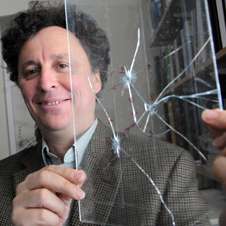
Karma examined how cracks form in different materials. Photo by Lauren McFalls.

(PhysOrg.com) -- In research published in the March 4 issue of the journal Nature, Northeastern University physicists have pioneered the development of large-scale computer simulations to assess how cracks form and proliferate in materials ranging from steel and glass to nanostructures and human bones.

For years, scientists have tried to understand the propagation of cracks and how they affect the materials in which they form, said Alain Karma, distinguished physics professor and lead investigator on the project.

“We now better understand what path cracks follow as they propagate in a stressed material,” said Karma, director of Northeastern’s Center for Interdisciplinary Research on . “This knowledge will allow us to develop — for advanced aircraft turbine blades, micro-electronic circuits and artificial bone — that better withstand destruction caused by cracks.”

Karma and the research team started out by examining the combined effects of two types of stress on crack propagation: shearing and tension. Shearing occurs naturally when material is twisted out of shape while tension occurs when material is pulled out of shape. The combination of shearing and tension causes crack instability. The mechanism for how this instability develops and spreads, however, remained elusive until Karma utilized the power of a computer.

Large-scale yielded the surprising result that shearing and cause cracks to take the shape of a helix. Based on the simulation results, Karma and his team developed a theoretical equation to predict how the helix would rotate, expand and multiply in different materials.

“The fundamental question we are answering is how these cracks grow inside materials, said Karma. “Now that we have that information, we can develop new materials to withstand cracks, as well as more effectively reduce the damage of cracks once they form.”

The research could yield innovations in the production of lighter automobile and aircraft parts that reduce energy consumption, and composite artificial bones that will not fracture when inside the body. The results also have implications for understanding the evolution of geologic faults and fractures in the earth’s crust.

Explore further: Iron-platinum alloys could be new-generation hard drives

Related Stories

New approach to understanding cracks

Feb 03, 2006

Could engineers have known ahead of time exactly how much pressure the levees protecting New Orleans could withstand before giving way? Is it possible to predict when and under what conditions material wear and tear will ...

Researchers Crack the Mystery of Resilient Teeth

Apr 17, 2009

(PhysOrg.com) -- After years of biting and chewing, how are human teeth able to remain intact and functional? A team of researchers from The George Washington University and other international scholars have ...

Flying by the skin of our teeth

Aug 19, 2009

It's been a mystery: how can our teeth withstand such an enormous amount of pressure, over many years, when tooth enamel is only about as strong as glass? A new study by Prof. Herzl Chai of Tel Aviv University's School of ...

Recommended for you

Promising doped zirconia

May 17, 2013

Materials belonging to the family of dilute magnetic oxides (DMOs)—an oxide-based variant of the dilute magnetic semiconductors—are good candidates for spintronics applications. This is the object of ...

Nanocrystals grow from liquid interface

May 17, 2013

An international collaboration of scientists has discovered a unique crystalizing behavior at the interface between two immiscible liquids that could aid in sustainable energy development.

User comments : 4

Adjust slider to filter visible comments by rank

Display comments: newest first

vantomic
not rated yet Mar 05, 2010
lol ya that title is kinda bad...but it should help us figure out how the cracks form on the surface of uranus. :p
seneca
not rated yet Mar 05, 2010
..scientists unlocked the mysteries.
Such "catchy" title dishonests whole article...
http://blogs.disc...809s.gif
PinkElephant
not rated yet Mar 05, 2010
Hmph. I expected a write-up about coca plants. Ah well....
El_Nose
not rated yet Mar 10, 2010
HORRIBLE title: short article - not much meat.

More news stories

Making quantum encryption practical

One of the many promising applications of quantum mechanics in the information sciences is quantum key distribution (QKD), in which the counterintuitive behavior of quantum particles guarantees that no one can eavesdrop on ...

Lab sets a new record for creating heralded photons

(Phys.org) —Entanglement, by general consensus of physicists, is the weirdest part of quantum science. To say that two particles, A and B, are entangled means that they are actually two parts of an inseparable ...

If you can remember it, you can remember it wrong

(Medical Xpress)—Native peoples in regions where cameras are uncommon sometimes react with caution when their picture is taken. The fear that something must have been stolen from them to create the photo ...

Encouraging signs for bee biodiversity

Declines in the biodiversity of pollinating insects and wild plants have slowed in recent years, according to a new study. Researchers led by the University of Leeds and the Naturalis Biodiversity Centre in the Netherlands ...

B vitamins could delay dementia

(Medical Xpress)—Despite spending billions of dollars on research and development, drug companies have been unable to come up with effective treatments for dementia and Alzheimer's Disease (AD). Now, A. ...

New method for producing clean hydrogen

Duke University engineers have developed a novel method for producing clean hydrogen, which could prove essential to weaning society off of fossil fuels and their environmental implications.