Female dung beetles use horns to fight over manure
Mar 04, 2010 by Lin Edwards report
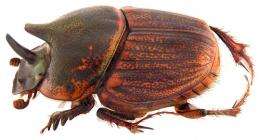
Dung beetle (Onthophagus sagittarius) Image credit: U.Schmidt.

(PhysOrg.com) -- Dung beetles are among the few species in which the females are more impressively equipped with armor than males, and a new study explains why: the females fight each other for the best manure and breeding sites.

University of Western Australia researchers, Prof. Leigh Simmons and Dr. Nicola Watson, studied the female (Onthophagus sagittarius), which, as its name suggests, feeds on dung. When they arranged for the females to have to race each other to reach deposits of cow dung and access to egg-laying sites in tunnels beneath the dung, those with larger horns were able to gather more manure, and thus provide more of this valuable resource for supporting their young.

In a study published in the , the researchers said competition between females for the use of breeding resources reduced the reproductive fitness of all the beetles, but smaller beetles were worse off than larger individuals. When matched for body size, the longest horns gave the greatest advantage in reproductive fitness, producing significantly more broods than beetles with shorter horns.

Dung beetles lay their eggs in balls of dung, which must be fresh for the beetles to use it and this is what leads to competition. Watson said there is a distinct advantage for females that can get to dung first and seize the best and freshest pieces. They have also been observed stealing dung from other females and replacing eggs with their own.

Dung beetles are also unusual in that the female dung beetles’ horns are of a different type to those of male beetles, and the scientists suggest this means they have evolved independently. Unlike male , they are not used for fighting off predators, defending territory, or competing for mates, but for fighting off other competing with them for resources.

Explore further: Honeybees trained in Croatia to find land mines

More information: Reproductive competition promotes the evolution of female weaponry, Nicola L. Watson, Leigh W. Simmons; Proceedings of the Royal Society B. doi:10.1098/rspb.2009.2335

Related Stories

Can't compete on dung? Try mating on apple pomace

Jun 24, 2009

In the mating world of yellow dung flies, large, brawny males almost always get the girl. However, a new study suggests that smaller males rule if presented with an opportunity to woo females when they are not hanging out ...

Armed beetles find a mate, whatever their size

Mar 27, 2008

One species of armed beetle is proving that size doesn’t necessarily matter when it comes to finding a mate. The creature’s ‘pulling techniques’ will be revealed in the April edition of the Royal En ...

Beetle dung helps forests recover from fire

Nov 29, 2007

Armed with a pair of tweezers and a handful of beetle droppings, University of Alberta forestry graduate Tyler Cobb has discovered why the bug-sized dung is so important to areas ravaged by fire.

Recommended for you

Honeybees trained in Croatia to find land mines

4 hours ago

(AP)—Mirjana Filipovic is still haunted by the land mine blast that killed her boyfriend and blew off her left leg while on a fishing trip nearly a decade ago. It happened in a field that was supposedly ...

Front-row seats to climate change

May 17, 2013

By day, insects provide the white noise of the South, but the night belongs to the amphibians. In a typical year, the Southern air hangs heavy from the humidity and the sounds of wildlife.

Captured in silken netting and sticky hairs

May 16, 2013

The great ecological success of spiders is often substantiated by the evolution of silk and webs. Biologists of the Kiel University and the University of Bern now found an alternative adaptation to hunting ...

User comments : 2

Adjust slider to filter visible comments by rank

Display comments: newest first

NamelessMaster
not rated yet Mar 04, 2010
That's funny...they use the same technique in the Junior League!
Jeswin
2 / 5 (1) Mar 10, 2010
Wow contradicts this sexual dimorphism in which males usually possess the distinguishing characteristics due to sexual selection via male competition

More news stories

Honeybees trained in Croatia to find land mines

(AP)—Mirjana Filipovic is still haunted by the land mine blast that killed her boyfriend and blew off her left leg while on a fishing trip nearly a decade ago. It happened in a field that was supposedly ...

Kinks and curves at the nanoscale

One of the basic principles of nanotechnology is that when you make things extremely small—one nanometer is about five atoms wide, 100,000 times smaller than the diameter of a human hair—they are going ...

Mice, gerbils perish in Russia space flight

A number of mice and eight gerbils sent into space in a Russian capsule destined to find out how well organisms can withstand extended flights perished during their journey, scientists said Sunday as the ...