Small is beautiful: Japan's hand-made electric cars
Mar 04, 2010 by Karyn Poupee
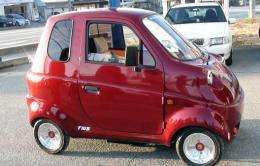
An environment-friendly car built by hand by a small family-run business at their garage-workshop in the snowy foothills of northwestern Toyama prefecture on February 24, 2010. While auto manufacturing giants spend millions to develop environmentally-friendly electric cars, one Japanese company has taken a more low-key approach, crafting hand-made "green" cars.

While auto manufacturing giants spend millions to develop environmentally-friendly electric cars, one Japanese company has taken a more low-key approach, crafting hand-made "green" cars.

Takeoka Jidosha Kogei may be the antithesis of the world's Hondas and Nissans. The family-run business makes its cars from scratch in a garage workshop in the snowy foothills in the northwest of the country.

There are no industrial robots or assembly lines in sight. Instead just a dozen mechanics crafting each model by hand, right up to the finishing touch of adding a set of beady headlights to their "Milieu" range.

The cars seem to owe much of their design to Japan's manga cartoon tradition -- their one-seater T-10 seems barely large enough for an adult driver, with just enough extra room left for a small pet, as requested by customers.

The box-shaped two-door car -- which is dubbed the "Eco-beagle" and comes in green, white, red and canary yellow -- has a relatively affordable price tag of 856,000 yen (9,600 dollars).

Company head Manabu Takeoka said he wants to change the image of minicars, which he said "are generally viewed as cars for the elderly, or for drivers who had their normal licences removed due to drunken driving".

"We've improved the shape of our latest model to make it cuter, to attract younger clients," he said.

Like other electric cars, it runs on a lithium-ion battery. It can also be charged from a conventional wall socket.

The latest model can drive up to 70 kilometres (45 miles) at 60 kilometres per hour when fully charged.

Takeoka's cars are aimed at rural households, which often have more than one car, as opposed to the cities, where more people opt for public transport to avoid the cost of parking.

The Takeoka lineup includes six models made from lightweight fibre-reinforced plastic, ranging from one- to four-seater cars. They measure less than three meters (10 feet) and weigh between 300 and 740 kilograms (660 to 1,600 pounds).

"People who buy our cars use them primarily to run errands or go shopping a few hundred metres from their homes. They don't need to charge the cars on the road if they already did so at home," said Takeoka.

Takeoka began its business in 1981 by building minicars for the disabled.

It started developing the electric cars in the 1990s with help from the local electricity company. Nearby Toyama University has since come on board, helping design the models.

The company also makes electric minicars specially designed for railway companies to inspect tunnels.

The may be a novelty, but they are unlikely to take the world by storm anytime soon, with sales currently at around 100 vehicles per year.

Asked whether there are plans to ramp up production, Takeoka exclaimed: "The company cannot build that many!"

Explore further: Energy-positive with natural ventilation

add to favorites email to friend print save as pdf

Related Stories

Tesla to unveil electric 5-seat sedan next week

Mar 19, 2009

US electric automaker Tesla Motors, which launched a breakthrough gas-free sports car last year, announced Thursday it will unveil in coming days a five-seat sedan, to roll off assembly lines by 2011.

Finnish firms announce electric car plans

Aug 06, 2009

Finnish engineering company Metso's unit Valmet Automotive and utility Fortum said Thursday they will jointly develop an electric concept car to be shown at the Geneva Motor Show in March 2010.

Taiwan, China may develop electric cars together

Nov 16, 2009

Taiwan and China are looking into developing electric cars together and will hold a conference here next week to seek areas where they can cooperate, a Taipei official said Monday.

Recommended for you

Energy-positive with natural ventilation

May 17, 2013

Buildings can be air-conditioned using entirely natural means, without mechanical ventilation systems. This is the claim made by 78-year-old Benjamin Bronsema, who will be awarded his PhD for his thesis on the subject at ...

CTRL+P: Printing Australia's largest solar cells

May 16, 2013

(Phys.org) —The printer has allowed researchers from the Victorian Organic Solar Cell Consortium (VICOSC) – a collaboration between CSIRO, The University of Melbourne, Monash University and industry partners ...

A storage power plant on the seabed

May 16, 2013

Norwegian research scientists will contribute to realising the concept of storing electricity at the bottom of the sea. The energy will be stored with the help of high water pressure.

User comments : 0

More news stories

Yahoo Japan suspects 22 million IDs stolen

Yahoo Japan Corp. has said it suspects up to 22 million user IDs may have been stolen during an unauthorised attempt to access the administrative system of its Yahoo! Japan portal.

US seizes Bitcoin operator accounts

US authorities seized the accounts of a Bitcoin digital currency exchange operator, claiming it was functioning as an "unlicensed money service business," court documents showed Friday.

Facebook, Twitter announce apps for Google's Glass

Google says it's still figuring out the best ways to use Glass, but the company announced Thursday that Facebook, Twitter and several other media firms have built their own applications for the futuristic-looking wearable ...

Galaxy's Ring of Fire

Johnny Cash may have preferred this galaxy's burning ring of fire to the one he sang about falling into in his popular song. The "starburst ring" seen at center in red and yellow hues is not the product of ...

New colonoscope provides ground-breaking view of colon

A ground-breaking advance in colonoscopy technology signals the future of colorectal care, according to research presented today at Digestive Disease Week(DDW). Additional research focuses on optimizing the minimal withdrawal ...