National stroke prevention study reveals surgery and stenting equally effective
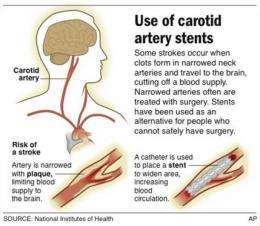
(PhysOrg.com) -- A major study shows that a minimally-invasive procedure is as effective and safe as the gold standard for treating blockages of the carotid artery, giving patients who prefer a less invasive procedure a proven alternative.
The Methodist Hospital in Houston is a top 10 enrolling site for the CREST study (Carotid Revascularization Endarterectomy vs. Stenting Trials), funded by the National Institute of Neurological Disorders and Stroke, part of the National Institutes of Health.
CREST, a randomized clinical study, compared carotid endarterectomy, a common operation to treat a narrowing of the carotid artery, with the study procedure, carotid artery stenting. During stenting, a catheter is used to deliver a stent into the carotid artery, where the stent can expand and widen the blocked area and capture any dislodged plaque. In the trial of 2,502 participants, results showed that people at risk for stroke can benefit equally from either medical procedure, designed to prevent future strokes.
Dr. Michael DeBakey performed the first carotid endarterectomy in 1953 at The Methodist Hospital.
“More than 55 years later, Dr. DeBakey’s legacy continues. He helped us set the standard for how we treat this population of patients, and now we have another viable treatment option,” said Dr. David Chiu, CREST principal investigator at Methodist and medical director of the Eddy Scurlock Stroke Center at the Methodist Neurological Institute.
One of the largest randomized stroke prevention trials ever, CREST took place at 117 centers in the United States and Canada over a nine-year period. The overall safety and efficacy of the two procedures was largely the same with equal benefits for both men and for women, and for patients with or without a previous stroke.
The study also found that the age of the patient made a difference.? At approximately age 69 and younger, stenting results were slightly better, with a larger benefit for stenting the younger the age of the patient.? For patients older than 70, surgical results were slightly superior to stenting, with greater benefits for surgery the older the age of the patient.
Stroke, the third leading cause of death in the United States, is caused by an interruption in blood flow to the brain by a clot or bleeding. The carotid arteries on each side of the neck are the major source of blood flow to the brain.? The buildup of cholesterol in the wall of the carotid artery, called atherosclerotic plaque, is one cause of stroke. Because people with carotid atherosclerosis also usually have atherosclerosis in the coronary arteries that supply the heart, the CREST trial tracked the rate of heart attacks, in addition to stroke and death.
In CREST, approximately half the patients had recent symptoms due to carotid disease such as a minor stroke, or a transient ischemic attack, indicating a high risk for future stroke. The other half had no symptoms but were found to have narrowing of the carotid artery on one of a variety of tests assessing carotid narrowing and plaque. Such patients, termed asymptomatic, are at much lower risk of stroke than those with symptoms.
Partial funding for the study was supplied by Abbott, the maker of the stents.


