NASA Breaks Ground on New Deep Space Network Antennas
Feb 25, 2010
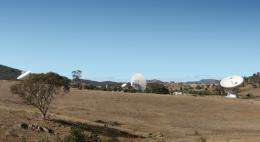
NASA's Deep Space Network is building new antennas to improve communications and the first phase will take place at the Canberra Deep Space Communication Complex in Australia. This image of the Canberra complex shows four Deep Space Network antennas. The Deep Space Network is managed by NASA's Jet Propulsion Laboratory in Pasadena, Calif. Image credit: NASA/JPL/CDSCC

(PhysOrg.com) -- NASA officials broke ground near Canberra, Australia on Wednesday, Feb. 24, beginning a new antenna-building campaign to improve Deep Space Network communications.

Following the recommendations of an independent study, embarked on an ambitious project to replace its aging fleet of 70-meter-wide (230-foot-wide) dishes with a new generation of 34-meter (112-foot) antennas by 2025.

The three 70-meter antennas, located at the NASA Deep Space Network complexes at Goldstone, Calif., Madrid, Spain, and Canberra, are more than 40 years old and show wear and tear from constant use.

The new antennas, known as "beam wave guide" antennas, can be used more flexibly, allowing the network to operate on several different frequency bands within the same . Their electronic equipment is more accessible, making maintenance easier and less costly. The new antennas also can receive higher-frequency, wider-bandwidth signals known as the "Ka band." This band, required for new NASA missions approved after 2009, allows the newer antennas to carry more data than the older ones.

In the first phase of the project near Canberra, NASA expects to complete the building of up to three 34-meter antennas by 2018. The decision to begin construction came on the 50th anniversary of U.S. and Australian cooperation in space tracking operations.

"There is no better way to celebrate our 50 years of collaboration and partnership in exploring the heavens with the government of Australia than our renewed commitment and investment in new capabilities required for the next five decades," said Badri Younes, deputy associate administrator for Space Communications and Navigation at NASA Headquarters in Washington.

Space Communications and Navigation is responsible for managing all NASA space communications and navigation resources and their operations. NASA's Jet Propulsion Laboratory manages the agency's , an important component of the agency's space communications resources.

NASA's goal is to integrate all NASA communications resources into a unified, far more capable network. Australia's Commonwealth Scientific and Industrial Research Organization manages the communication complex near Canberra for NASA.

Explore further: Building a better team—on Mars

add to favorites email to friend print save as pdf

Related Stories

NASA Unveils New Antenna Network in White Sands, N.M.

Nov 09, 2007

Engineers from NASA’s Goddard Space Flight Center in Greenbelt, Md., showcased the new 18-meter Ka Band Antenna Network, the first such system in agency history, during a ribbon-cutting ceremony at the White ...

TDRS spacecraft pass system level reviews

Feb 22, 2010

NASA's Tracking and Data Relay Satellite (TDRS) K-L program completed its Critical Design Review (CDR) and Production Readiness Review (PRR) in El Segundo, Calif. on Feb. 19.

NASA commemorates its 50th anniversary

Sep 06, 2007

The National Aeronautics and Space Administration has joined with Discovery Communications to commemorate the U.S. space agency's 50th anniversary.

Spacecraft Talk Continued During JPL Wildfire Threat

Sep 10, 2009

As the flames of the raging brush fire dubbed the Station Fire threatened the northern edge of NASA's Jet Propulsion Laboratory on Saturday, Aug. 29, the managers of NASA's Deep Space Network prepared for ...

Saturn's Icy Moon Iapetus

Jan 04, 2005

NASA's Cassini spacecraft successfully flew by Saturn's moon Iapetus at a distance of 123,400 kilometers (76,700 miles) on Friday, Dec. 31. NASA's Deep Space Network tracking station in Goldstone, Calif., received ...

Recommended for you

Building a better team—on Mars

15 hours ago

Sometime in the next quarter-century, NASA plans to send the first humans to Mars, a mission that will push the boundaries of teamwork for a handful of astronauts who will spend as long as three years together ...

User comments : 0

More news stories

NASA's BARREL mission launches 20 balloons

(Phys.org) —In Antarctica in January, 2013 – the summer at the South Pole – scientists released 20 balloons, each eight stories tall, into the air to help answer an enduring space weather question: ...

Power of US tornado dwarfs Hiroshima bomb

Wind, humidity and rainfall combined precisely to create Monday's massive killer tornado in Oklahoma. The awesome amount of energy released dwarfed the power of the atomic bomb that leveled Hiroshima.

If you can remember it, you can remember it wrong

(Medical Xpress)—Native peoples in regions where cameras are uncommon sometimes react with caution when their picture is taken. The fear that something must have been stolen from them to create the photo ...

Encouraging signs for bee biodiversity

Declines in the biodiversity of pollinating insects and wild plants have slowed in recent years, according to a new study. Researchers led by the University of Leeds and the Naturalis Biodiversity Centre in the Netherlands ...

B vitamins could delay dementia

(Medical Xpress)—Despite spending billions of dollars on research and development, drug companies have been unable to come up with effective treatments for dementia and Alzheimer's Disease (AD). Now, A. ...