Aspen's 'dandelion' habits challenge mountain evergreens
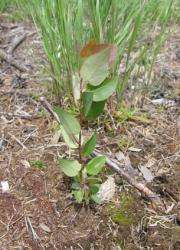
(PhysOrg.com) -- The face of high-elevation evergreen forests in Western Canada could be drastically altered as a combination of climate change, human and natural disturbances is making spruce and pine forests in the Rocky Mountains vulnerable to a slow but steady invasion of aspen trees.
And while these broad-leaf aspen also feed the logging industry, they could challenge caribou and other animal and plant species dependent on evergreen habitat for food and shelter, says a new University of Alberta study.
"Some hot-button issues such as our woodland caribou populations could be influenced by this change in habitat, as animals use these pine stands," said Simon Landhäusser, a professor in the U of A's School of Forest Science and Management, and co-author on the study. He studies how forests recover from natural or man-made disturbances.
While aspen isn't usually known for establishing itself from seed and growing at high elevations in the Alberta Rockies, it has begun to appear among the pine and spruce forests. Potentially, the annual leaf litter from aspen could choke out vegetation growing close to the ground that supports animals like the caribou, who feed on lichens growing in pine forests.
"Under a warming climate, aspen is given a chance to invade these new areas when disturbances such as logging or fire create soil conditions that are good for aspen seedlings," Landhäusser said. "Aspen is the dandelion of trees," he added. "It is well-equipped to invade new areas over large distances by producing millions of seeds that can be carried by the slightest breeze with its light cotton fluff."
The two-year study of recently logged or burned land revealed aspen seedlings regenerated up to 200 metres higher in elevation than where aspen in the original mature undisturbed forests currently occurs. Virtually no seedlings were established on sites that had little or no forest floor disturbance, the research showed.
"This change in forest composition at higher elevations is likely driven by a warming climate; however, the natural and human-caused disturbances to the forest floor appear to greatly accelerate this change," Landhäusser said. "This means local species need to either adapt to the new conditions or they must migrate further upslope to follow the evergreen forest where aspen currently can't grow."
As a result, future forest and wildlife management practices in these areas may need altering to adjust for these conditions, Landhäusser said.
The aspen invasion could have an upside in the long term, though, he added.
"In the next 100 years, a mixture of aspen, spruce and pine forests at higher elevations has the potential to provide more productive forests, like those currently found at lower elevations. These forests have a greater natural resiliency against disturbances and pests, and would likely be less affected by insect outbreaks that focus on single-tree species, such as Mountain Pine Beetle which would maintain overall forest cover and wood supply."
The research, funded by a grant from the Natural Sciences and Engineering Research Council of Canada, was published recently in the Journal of Biogeography.
Provided by University of Alberta


