Breakthrough technology for testing Alzheimer's and Parkinson's drugs
Feb 18, 2010
Breakthrough technology for testing Alzheimer's and Parkinson's drugs
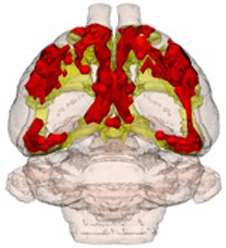
Visualization of activated neural networks using the Ekam Brain Atlas.

(PhysOrg.com) -- In a breakthrough development for early drug research, Northeastern University scientists are now able to test, in real time, the impact of new drugs being developed to treat neurodegenerative diseases like Alzheimer's and Parkinson's.

A patented new imaging technology developed by Northeastern’s Center for Translational NeuroImaging (CTNI) enables researchers to produce highly accurate data without resorting to traditional preclinical testing methods. Those methods involve euthanizing laboratory animals at different stages of the study to assess disease progression and the effectiveness of the drug.

“Animal imaging is crucial in early , but the use of anesthesia creates an artificial situation that can mask true drug activity,” said Craig Ferris, CTNI director and professor of psychology and pharmaceutical sciences. “Studying awake animals leads to improved drug safety evaluations and data accuracy.”

Ferris noted the testing they are now able to perform at CTNI maximizes accuracy and leads to improved processes for pharmaceutical and biotechnology companies that are working to treat diseases, including Alzheimer’s and Parkinson’s diseases.

The center’s imaging-based preclinical testing is performed under the aegis of a new business venture, called Ekam Imaging, Inc., founded by a team that includes Ferris and Graham Jones, professor and chair of the department of chemistry and chemical biology at Northeastern.

The technology has spawned eight patents focused on the imaging of animals and a new method for tagging drugs using microwave-mediated organic synthesis technology. This procedure allows injected compounds to be more accurately tracked and evaluated for efficacy.

Additionally, the center uses advanced data-analysis techniques, including three-dimensional brain “atlases” used for data visualization, and imaging models of various disease conditions.

“The advantages of our technology give researchers the ability to provide information and analysis to drug companies that enable them to make more informed go/no-go decisions on their drug development programs,” added Ferris. “It will help reduce the time to market for new therapeutics and lower the overall cost of drug development.”

Explore further: Experts favor US approval of Merck sleeping pill (Update)

add to favorites email to friend print save as pdf

Related Stories

Data mining promises to dig up new drugs

Feb 02, 2009

(PhysOrg.com) -- A robot scientist that can make informed guesses about how effective different chemical compounds will be at fighting different diseases could revolutionise the pharmaceutical industry by ...

Business of drug development on verge of great change

Apr 01, 2008

Significant changes to drug discovery and the pharmaceutical industry currently underway will increase in the next five to 10 years, according to a top researcher at the National Institutes of Health (NIH) who is helping ...

Delivering drugs on time and on target

Feb 04, 2010

(PhysOrg.com) -- Northeastern professor leading research on nanocarriers that would make a whole new class of drugs available to treat cancer and other diseases

Animal TB 'tracker' to speed drug and vaccine studies

Jul 22, 2009

Johns Hopkins researchers have developed a novel way to monitor in real time the behavior of the TB bacterium in mouse lungs noninvasively pinpointing the exact location of Mycobacterium tuberculosis. The ...

Crystal clear savings for drug giants

Jun 06, 2008

Drug companies could save millions thanks to a new technology to monitor crystals as they form. The technique, developed by University of Leeds engineers, is a potentially invaluable tool in drug manufacture, ...

Recommended for you

Glaxo, US partnering to develop new antibiotics

13 hours ago

GlaxoSmithKline PLC says it's starting an unusual collaboration with the U.S. government to develop several antibiotics for both bioterrorism threats and bacterial infections resistant to current medicines.

New sleeping pill poised to hit US markets

May 21, 2013

An experimental sleeping pill from US drug company Merck is effective at helping people fall and stay asleep, according to reviewers at the US Food and Drug Administration, which could soon approve the new drug.

Global recommendations on child medicine

May 21, 2013

Transparent information on the evidence supporting global recommendations on paediatric medicines should be easily accessible in order to help policy makers decides on what drugs to include in their national drug lists, according ...

User comments : 0

More news stories

Brain can be trained in compassion, study shows

Until now, little was scientifically known about the human potential to cultivate compassion—the emotional state of caring for people who are suffering in a way that motivates altruistic behavior.

Scientists announce Top 10 New Species from 2012

An amazing glow-in-the-dark cockroach, a harp-shaped carnivorous sponge and the smallest vertebrate on Earth are just three of the newly discovered top 10 species selected by the International Institute for ...