Blind people use both visual and auditory cortices to hear
(PhysOrg.com) -- Blind people have brains that are rewired to allow their visual cortex to improve hearing abilities. Yet they continue to access specialized areas to recognize human voices, according to a study published in Neuropsychologia by Frédéric Gougoux and Franco Lepore of the Université de Montréal Department of Psychology.
“By using their visual cortex, the blind are better than the sighted at recognizing notes, octaves and the origin of sounds,” says Dr. Lepore, of the Centre de recherche en neuropsychologie et cognition (CERNEC), which is part of the Department of Psychology, has conducted several studies on the brains of people with vision loss.
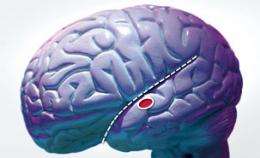
The superior temporal sulcus (STS) is a part of the brain specialized in recognizing the human voice. With just one spoken word the STS can infer the sex, age, emotional state and social standing of the speaker. Gougoux wanted to know if the blind use their STS as much as the sighted or if they outsourced this function to part of their visual cortex.
Blind test subjects were presented various sounds ranging from car horns to simple vocal stimuli as people pronouncing vowels. Their brain activity was measured using an MRI. The test confirmed that the blind use both the visual and auditory cortices to hear. Gougoux surprisingly discovered the blind still use the STS to decipher human voices and use it more than the sighted.
The study also revealed a correlation between the higher STS activation rate in the blind and their ability to distinguish vocal and non-vocal stimuli. “In addition to the transmodal specialization between the visual and auditory cortices, there is an expansion of the STS auditory zone. It is this cerebral plasticity that increases the hearing abilities of the blind,” says Dr. Lepore. “Voice recognition is a highly specialized function relying on a preprogrammed circuit just like the one used in facial recognition.”
Dr. Lepore is referring to the part of the brain (at the junction of the temporal and occipital lobes) used to recognize faces. The ability to identify faces and voices have developed these parts of the brain, which is clearly an adaptive feature of human survival.
More information: Neuropsychologia study


