Researchers Envision High-Tech Applications For 'Multiferroic' Crystals
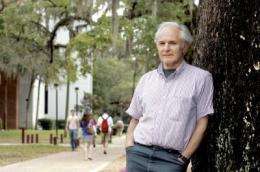
(PhysOrg.com) -- Two of The Florida State University’s most accomplished scientists recently joined forces on a collaborative research project that has yielded groundbreaking results involving an unusual family of crystalline minerals. Their findings could lay the groundwork for future researchers seeking to develop a new generation of computer chips and other information-storage devices that can hold vast amounts of data and be strongly encrypted for security purposes.
Working with a team of researchers from various disciplines, Naresh S. Dalal and Sir Harold W. “Harry” Kroto, both world-renowned chemists and educators, took a close look at a family of crystals known as metal-organic frameworks, or MOFs. Employing both laboratory experimentation and computational analysis, they found that four such crystals possessed properties that rarely coexist.
“We identified these four crystals as ‘multiferroic,’ meaning that they are simultaneously ferromagnetic and ferroelectric in nature when cooled to a specific temperature,” said Dalal, Florida State’s Dirac Professor of Chemistry and Biochemistry. (Ferromagnetism means a material possesses magnetic poles, while ferroelectricity refers to a material that possesses positive and negative electrical charges that can be reversed when an external electrical field is applied.)
“Normally, these two properties are mutually exclusive,” Dalal said. “Most materials are either ferromagnetic or ferroelectric based on the number of electrons in the ion’s outer electron shell. Therefore, finding four multiferroic materials at one time is quite scientifically significant and opens numerous doors in terms of potential applications.”
Multiferroic materials have been a hot topic of research in recent years, with researchers finding applications in the areas of hydrogen storage and the design of advanced optical elements, among others. Kroto sees another potential use: in the creation of high-powered computer memories and other data storage devices that can hold far more information than is currently possible.
“Theoretically, it might be possible to design devices that are much smaller and faster than the ones we use today to store and transmit data,” said Kroto, a Francis Eppes Professor in Florida State’s Department of Chemistry and Biochemistry. “And with data split over two mediums, information could be encrypted in a way that makes it far more secure than is currently possible. This could have wide-ranging applications in areas as diverse as the aeronautics industry, the military, the workplace and even the average consumer’s home.”
Dalal pointed to another possible benefit — high-tech devices that make far less of an environmental impact.
“The four new multiferroic crystals that we have identified all substitute other, less toxic metals for lead, which is a potent neurotoxin,” he said. “By reducing the amount of lead that enters landfills, we also reduce the amount that enters our water supply — and our bodies.”
Dalal, Kroto and their colleagues recently published a paper on their findings in the peer-reviewed Journal of the American Chemical Society (JACS). Their research was then summarized in a second article published in the prestigious international science journal Nature.
“On the basis of the type of materials research I was keen to initiate here at Florida State, it was natural to collaborate with Dr. Dalal due to his deep understanding of the complexities of phase transitions,” Kroto said. “It is in particular the subtle aspects of phase behavior, well beyond those traditional ones exhibited by normal gases, liquids and solids, that led to this work being highlighted recently by Nature and Angewandte Chemie.”
Provided by Florida State University


