Darwin descended from Cro-Magnon man: scientists
Feb 04, 2010
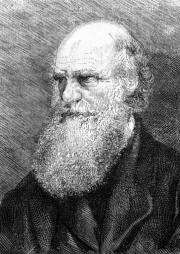
This undated engraving shows English naturalist Charles Darwin. The father of evolution was a direct descendant of the Cro-Magnon people, whose entry into Europe 30,000 years ago heralded the demise of Neanderthals, scientists revealed in Australia Thursday.

The father of evolution Charles Darwin was a direct descendant of the Cro-Magnon people, whose entry into Europe 30,000 years ago heralded the demise of Neanderthals, scientists revealed in Australia Thursday.

Darwin, who hypothesised that all humans evolved from common ancestors in his seminal 1859 work "On the ", came from Haplogroup R1b, one of the most common European male lineages, said genealogist Spencer Wells.

"Men belonging to Haplogroup R1b are direct descendants of the Cro-Magnon people who, beginning 30,000 years ago, dominated the human expansion into Europe and heralded the demise of the Neanderthal species," Wells said.

Director of the Genographic Project, an international study mapping the migratory history of the human species, Wells said they took a DNA sample from Darwin's great-great grandson Chris Darwin, 48, who lives on the outskirts of Sydney.

A trace of Darwin's "deep ancestry" showed his forefathers left Africa around 45,000 years ago, splitting into a new lineage 5,000 years later in Iran or southern Central Asia, Wells said.

"Before heading west towards Europe, the next mutation, which defined a new lineage, appeared in a man around 35,000 years ago,' he said.

"Approximately 70 percent of men in southern England belong to Haplogroup R1b, and in parts of Ireland and Spain that number exceeds 90 percent", he added.

Chris Darwin, whose great-grandfather was Darwin's astronomer son George, is a tour guide and adventurer in the Blue Mountains west of Sydney.

He migrated to Australia in 1986 and tests of his maternal DNA showed he was likely directly descended from the women who crossed the rugged Caucasus Mountains in southern Russia to reach the steppes of the Black Sea.

"The Genographic Project is incredibly important," Darwin said.

"The project is one way to show us the true story of humanity, of how we migrated across the world and that we are all related, tracing back to a small group of men and women who lived in Africa".

Wells was presenting the findings ahead of the project's annual scientific conference, bringing together representatives from 11 regional teams to discuss their work in Sydney.

There are currently 265,000 members of the public taking part in the project, which is an initiative of National Geographic, IBM and the California-based Waitt Family Foundation charity.

Participation kits can be bought online for 100 US dollars, and proceeds go towards the research and to indigenous language and cultural projects.

Explore further: New formula invented for microscope viewing, substitutes for federally controlled drug

add to favorites email to friend print save as pdf

Related Stories

Study shows 28,000 year-old Europeans' DNA was like ours

Jul 16, 2008

40,000 years ago, the Cro-Magnoid people – the first people who had a skeleton that looked anatomically modern – entered Europe, coming from Africa. In the July 16 issue of the open-access journal PLoS ONE, a group of gen ...

Early human populations evolved separately for 100,000 years

Apr 24, 2008

A team of Genographic researchers and their collaborators have published the most extensive survey to date of African mitochondrial DNA (mtDNA). Over 600 complete mtDNA genomes from indigenous populations across the continent ...

Long lost sisters

May 15, 2008

The human race was divided into two separate groups within Africa for as much as half of its existence, says a Tel Aviv University mathematician. Climate change, reduction in populations and harsh conditions may have caused ...

Recommended for you

Turning up the heat on biofuels

May 16, 2013

(Phys.org) —The production of biofuels from lignocellulosic biomass would benefit on several levels if carried out at temperatures between 65 and 70 degrees Celsius. Researchers with the Energy Biosciences ...

Getting to the root of better crops

May 16, 2013

(Phys.org) —The more crop scientists know about how plant roots take up water and nutrients, the better able they will be to develop crop plants with roots that can cope with challenging soil and environmental ...

User comments : 0

More news stories

Honeybees trained in Croatia to find land mines

(AP)—Mirjana Filipovic is still haunted by the land mine blast that killed her boyfriend and blew off her left leg while on a fishing trip nearly a decade ago. It happened in a field that was supposedly ...

Heat-related deaths in Manhattan projected to rise

Residents of Manhattan will not just sweat harder from rising temperatures in the future, says a new study; many may die. Researchers say deaths linked to warming climate may rise some 20 percent by the 2020s, ...

Kinks and curves at the nanoscale

One of the basic principles of nanotechnology is that when you make things extremely small—one nanometer is about five atoms wide, 100,000 times smaller than the diameter of a human hair—they are going ...