Prometheus: Over Easy
Jan 29, 2010
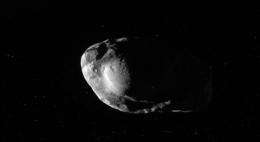
Prometheus displayed its pockmarked, irregular surface for NASA's Cassini spacecraft on Jan. 27, 2010. Image credit: NASA/JPL/Space Science Institute

(PhysOrg.com) -- Looking for all intents and purposes like a celestial egg after a session in Saturn's skillet, Prometheus displayed its pockmarked, irregular surface for NASA's Cassini spacecraft on Jan. 27, 2010.

Prometheus is one of Saturn's innermost moons. It orbits the gas-giant at a distance of 139,353 kilometers (85,590 miles) and is 86 kilometers (53 miles) across at its widest point.

The porous, icy-bodied world was originally discovered by images taken by Voyager 1 back in 1980. You could say this latest "egg-cellent" view has the Cassini science team licking their chops at the thought of future Prometheus images.

This raw, unprocessed image of Prometheus [pro-MEE-thee-us] , taken in , was obtained by Cassini's narrow-angle camera at a distance of approximately 36,000 kilometers (23,000 miles).

Explore further: Engineering students develop a super 'space stethoscope'

add to favorites email to friend print save as pdf

Related Stories

Saturn Moons In Ghostly Specter

Mar 08, 2006

Ghostly details make this dark scene more than just a beautiful grouping of two Saturn moons, with Tethys on the left and Titan on the right.

Cassini finds Prometheus a sculptor of Saturn's rings

Oct 26, 2005

New findings from members of the Cassini imaging team show that certain prominent features in Saturn's narrow and contorted F ring can be understood in terms of a simple gravitational interaction with the ...

Rhea's Wisps in Color

Feb 28, 2006

Bright, wispy markings stretch across a region of darker terrain on Saturn's moon Rhea. In this extreme false-color view, the roughly north-south fractures occur within strips of material (which appear greenish ...

Cassini Attempts 12th Titan Flyby

Feb 28, 2006

NASA's Cassini spacecraft returns to Titan on Monday for its twelfth flyby since beginning to survey Saturn and its moons on July 4, 2004.

Recommended for you

Forecast for Titan: Wild weather could be ahead

9 hours ago

(Phys.org) —Saturn's moon Titan might be in for some wild weather as it heads into its spring and summer, if two new models are correct. Scientists think that as the seasons change in Titan's northern hemisphere, ...

SDO observes mid-level solar flare

9 hours ago

UPDATE 16:30 p.m. EDT: The M7-class flare was also associated with a coronal mass ejection or CME, another solar phenomenon that can send billions of tons of particles into space. While this CME was not Ea ...

NASA's IRIS mission readies for a new challenge

19 hours ago

(Phys.org) —The time draws near. NASA is getting ready to launch a new mission, a mission to observe a largely unexplored region of the solar atmosphere that powers its dynamic million-degree outer atmosphere and drives ...

User comments : 0

More news stories

Forecast for Titan: Wild weather could be ahead

(Phys.org) —Saturn's moon Titan might be in for some wild weather as it heads into its spring and summer, if two new models are correct. Scientists think that as the seasons change in Titan's northern hemisphere, ...

Theorists weigh in on where to hunt dark matter

(Phys.org) —Now that it looks like the hunt for the Higgs boson is over, particles of dark matter are at the top of the physics "Most Wanted" list. Dozens of experiments have been searching for them, but ...