'Squeaker' catfish communicate across generations

Jan 29, 2010
This is an auditory evoked potential recording. Credit: Lechner et al., BMC Biology

It has been thought that young fish, lacking well-developed hearing organs, could not perceive the sounds made by their larger, older relatives. Now, researchers writing in the open access journal BMC Biology have used a combined fish tank and sound-proof chamber to show for the first time that catfish of all ages can communicate with one another.

Walter Lechner and a team of researchers from the University of Vienna studied the Synodontis schoutedeni, which, by rubbing the spines of its pectoral fins into grooves on its shoulder, is able to create a 'squeaking' sound. He said, "This study is the first to demonstrate that absolute hearing sensitivity changes as catfish grow up. This contrasts with prior studies on the closely related and , in which no such change could be observed. Furthermore, S. schoutedeni can detect sounds at all stages of development, again contrasting with previous findings".

The catfish use the squeaking sound to warn of predators and during competition between members of the species. By investigating the animals in specially modified tanks, Lechner and his colleagues were able to record the sounds made and perceived by fish of various sizes, from very young to adult. He said, "We found that as fish get larger, the sounds they make increase in level and duration. sensitivities increase with growth, but even the youngest fish are capable of communicating over short distances".
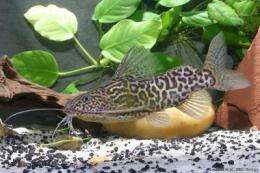
This is a Synodontis schoutedeni catfish. Credit: Oliver Drescher


Explore further: White tiger mystery solved

More information: Ontogenetic development of auditory sensitivity and sound production in the squeaker catfish Synodontis schoutedeni, Walter Lechner, Lidia Eva Wysocki and Friedrich Ladich, BMC Biology, www.biomedcentral.com/bmcbiol/

add to favorites email to friend print save as pdf

Related Stories

Eel-like catfish can 'walk' on land

Apr 13, 2006

A researcher at Belgium's Ghent University reportedly has discovered an eel-like catfish that can wriggle out of the water to stalk prey on land.

Poisonous Poisson

Dec 04, 2009

In contrast to the exhaustive research into venom produced by snakes and spiders, venomous fish have been neglected and remain something of a mystery. Now, a study of 158 catfish species, published in the ...

Study Shows Sonar Did Not Harm Fish

Jul 05, 2007

A new University of Maryland study in the July issue of the Journal of the Acoustical Society of America reports that high powered sonar, like that used by U.S. Navy ships, did not harm test fish, including their ...

Recommended for you

White tiger mystery solved

1 hour ago

White tigers today are only seen in zoos, but they belong in nature, say researchers reporting new evidence about what makes those tigers white. Their spectacular white coats are produced by a single change ...

Scientists announce Top 10 New Species from 2012

8 hours ago

An amazing glow-in-the-dark cockroach, a harp-shaped carnivorous sponge and the smallest vertebrate on Earth are just three of the newly discovered top 10 species selected by the International Institute for ...

New cave-dwelling arachnids discovered in Brazil

20 hours ago

Two new species of cave-dwelling short-tailed whipscorpions have been discovered in northeastern Brazil, and are described in research published May 22 in the open access journal PLOS ONE by Adalberto Santos ...

User comments : 0

More news stories

White tiger mystery solved

White tigers today are only seen in zoos, but they belong in nature, say researchers reporting new evidence about what makes those tigers white. Their spectacular white coats are produced by a single change ...

Unlocking secrets of cell reproduction

Research published in Open Biology today identifies, for the first time, nearly all the genes required for reproduction of a cell in a living organism.

Amazon expands Kindle tablet sale to 170 countries

Online retail titan Amazon announced Thursday it is expanding sales of its Kindle tablet computers to "over 170 countries and territories around the world," and its Appstore in nearly 200 countries.

Google to add Galapagos Islands to Street View

Few have explored the remote volcanic islands of the Galapagos archipelago, an otherworldly landscape inhabited by the world's largest tortoises and other fantastical creatures that inspired Charles Darwin's theory of evolution.