Is the Hobbit's brain unfeasibly small?
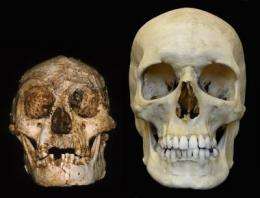
(PhysOrg.com) -- The commonly held assumption that as primates evolved, their brains always tended to get bigger has been challenged by a team of scientists at Cambridge and Durham. Their work helps solve the mystery of whether Homo floresiensis - dubbed the Hobbit due to its diminutive stature - was a separate human species or a diseased individual.
The team combined previously published datasets of brain and body mass with measurements from fossil remains. They then used three different mathematical methods to reconstruct patterns of brain evolution across the primate family tree from these 37 existing and 23 extinct primate species.
The results show that while brains evolved to be larger in both relative and absolute terms along most branches of the primate family tree, the opposite happened along several lineages. For example brain size shrank during the evolution of Mouse Lemurs, Marmosets and Mangabeys.
In contrast, the study found no overall trend to increase body size, suggesting that brain and body mass have been subject to separate selection pressures in primates.
Gorillas, for example, have large brains but the increase in body mass during the evolution of modern gorillas greatly exceeds the increase in brain mass. Conversely, lineages leading to other primates, such as Gibbons and Colobus monkeys show an increase in brain mass but a decrease in body mass.
The findings may help solve the mystery of "the Hobbit" or Homo floresiensis. This metre-high early human species shared the planet with our species until 13,000 years ago. Its discovery on the Indonesian island of Flores in 2003 sparked a long-running debate, some scientists arguing that it was a new human species while others believed disease was more likely to be responsible for its small size.
According to co-author Stephen Montgomery of the University of Cambridge: "The discovery challenged our understanding of human evolution and created much debate about whether H. floresiensis was a distinct species or a diseased individual."
"Much of the debate about the place of H. floresiensis in the primate tree is centered around its small size, in particular the small brain size. The argument raised has been that the evolution of such a small brain does not fit with what we know about primate brain evolution.
"Our analysis, together with studies of brain size in island populations of living primates, suggests we should perhaps not be surprised by the evolution of a small brained, small bodied early human species."
The findings also deepen our understanding of how our brains and bodies have evolved and the selection pressures that may have been responsible. The results show that selection has acted in both directions, usually resulting in evolution of bigger brains but also producing smaller ones.
This is the first study to reconstruct the pattern of brain evolution across all primates. Previous studies by other researchers have looked at possible advantages and disadvantages of increased brain size in primates, but few consider how often, when, or where in the primate family tree these changes have happened.
According to lead author Dr Nick Mundy of the University of Cambridge: "A trend towards brain expansion is assumed to have occurred throughout primate evolution. This has been interpreted as an indication of selection for cognitive abilities due, for example, to 'arms races' in the ability to process social information."
"We found decreases in brain mass along several branches across the primate family tree. It is likely that reductions in brain size occurred to meet demands of the species' changing ecological needs meaning that sometimes individuals with smaller brains are favoured by natural selection."
"Periods of primate evolution which show decreases in brain size are of great interest as they may yield insights into the selective pressures and developmental constraints acting on brain size."
Primates have relatively large brains for their body size compared with other mammals. The world's smallest primate brain belongs to the grey mouse lemur (Microcebus murinus), whose brain weighs just 1.8g (half as much as a UK one penny piece). The heaviest primate brain belongs to humans, weighing in at 1330g.
Brain expansion began early in primate evolution, suggesting brain expansion had a significant role in the origin and success of modern primates. Absolute brain mass is striking in humans but large brains have evolved several times in primates - for example Capuchins are South American monkeys which rival apes in terms of relative brain size. Indeed in the wild some populations of Capuchins are known to use tools to exploit novel food resources.
Recent studies show brain size decreased in other vertebrate lines, including birds, bats and elephants, as well as the cow and hippo families.
The research is published this week in BMC Biology.
Provided by University of Cambridge


