Bill Gates says innovation can leverage change
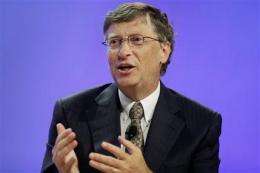
(AP) -- The needs of the poor are greater than the money available to help them, but that's not enough to discourage Bill Gates in his work as co-chair of the world's largest charitable foundation.
In his second annual letter, issued Monday, Gates says investment in science and technology can leverage those dollars and make more of a difference than charity and government aid alone.
In his 19-page letter, Gates says the foundation currently is backing 30 areas of innovation including online learning, teacher improvement, malaria vaccine development, HIV prevention, and genetically modified seeds.
The Seattle-based foundation focuses most of its donations on global health, agriculture development and education. Since 1994, the foundation has committed to $21.3 billion in grants. As of Sept. 30, 2009, its endowment totaled $34.17 billion.
Gates said his and his wife's experience at Microsoft Corp. is not the only reason they are so taken with technology.
"Melinda and I see our foundation's key role as investing in innovations that would not otherwise be funded," he wrote. "This draws not only on our backgrounds in technology but also on the foundation's size and ability to take a long-term view and take large risks on new approaches."
Gates begins his letter by talking about how much fun he's having at his new job: 2009 was the first year he worked full-time as co-chair of the foundation, after a decade of part-time work as he led Microsoft full-time.
He talks about enjoyable visits around the world to talk to scientists, politicians, teachers, farmers and people doing the work of the foundation.
"Seeing the work firsthand reminds me of how urgent the needs are as well as how challenging it is to get all the right pieces to come together," Gates wrote. "I love my new job and feel lucky to get to focus my time on these problems."
He talked about the way he and Melinda work as partners at the foundation, each focusing on problems that interest them and then sharing what they've learned and making decisions together on what the foundation should do.
Nearly seven pages of the letter focus on the foundation's work in global health and repeatedly Gates admits the work to reach the foundation's ambitious goals is harder than they expected.
Vaccine development is progressing, but the cost to provide those vaccines to the poor is still a problem. It's going to be difficult to meet a six-year goal to get the retrovirus vaccine to more than half the kids who need it.
Bed nets are helping decrease malaria deaths over Africa, but "malaria is a particularly tricky disease," Gates acknowledges. The foundation has resorted to a very expensive scattershot approach to meeting Bill and Melinda's goal of eradicating malaria, with many researchers pursuing a lot of different ideas.
Despite having one vaccine in a Phase III trial, an effective malaria vaccine is still 8 to 15 years away, he said.
The economy rates a paragraph at the beginning and about two pages at the end of Gates' letter. He expressed concerns that budget deficits in the richest nations leading them to cut foreign assistance. He applauds Canada and Australia for their significant efforts and chastises Italy for not doing enough. Gates commended President Barack Obama for his proposal to double international aid.
The letter ends with Gates' explanation about why the foundation hasn't gotten involved in working to fight climate change, despite its potential impact on the poorest nations.
He said he believes developing electricity that is cheaper than coal and emits no greenhouse gasses is the most important innovation to help fight climate change, but the foundation has not yet found a way it can play a unique role in this area. He added, however, that outside of the foundation he personally is investing in energy research.
"I am surprised that the climate debate hasn't focused more on encouraging R&D since it is critical to getting to zero emissions," said the man who admits to spending some of his spare time watching online MIT lectures on physics and chemistry.
©2010 The Associated Press. All rights reserved. This material may not be published, broadcast, rewritten or redistributed.


