Mountain plants unable to withstand invasion
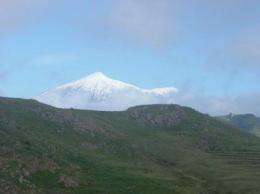
At the peak of Teide (Tenerife) invasive plants also invade the indigenous territories. Credit: José Ramón Arévalo
An international research team has studied the distribution of plant species in mountainous environments. The study shows that mountain plant communities are not particularly resistant to invasion by exotic species. The scientists also warn that these may become more aggressive as global warming gets a grip.
In 2005, scientists from various science centres in Spain, Germany, Switzerland, Australia, the United States and Chile created the Mountain Invasion Research Unit (MIREN) in order to study the distribution of exotic species in high mountain species and to design experiments to confirm the invasive capacity of certain species in high mountain environments.
"These plant communities in Alpine environments have until now not been thought particularly vulnerable to this kind of environmental disturbance", José Ramón Arévalo, one of the authors of the study and a researcher at the Department of Ecology of the University of La Laguna, tells SINC. However, the experiments show clearly "that the beliefs about this supposed protection and mountain species' resistance to invasive species is erroneous", he adds.
The study, published recently in Frontiers in Ecology and The Environment, and which is part of the work done by MIREN, has made it possible to identify the factors that make plants in these areas more vulnerable to invasion by other species.
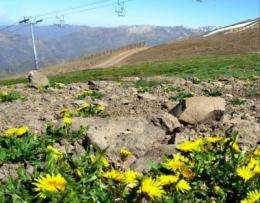
The invasive plant dandelion (Taraxacum officinale) reaches ecosystems mountain of the Andes in Chile. Credit: Anibal Pauchard
Among other factors, the scientists stress the ease of movement of propagules (plants which can reproduce asexually in order to produce new plants) as a result of human activity and the increase in environmental disturbance, the low levels of biological resistance of invaded plant communities, the increase in transport between high mountain areas that are far apart from each other, and the risks according to climate change models, "which will make it easier for invasive plants to establish themselves and reproduce", the ecologist explains.A work agenda to stem invasions
The work carried out over the last five years shows that "invasions may be a factor in more extensive and serious disturbance than had ever been thought", says Arévalo. The scientists also say there is a need to establish a work agenda to evaluate "not only current invasions, but also those that could happen in the future in mountainous environments", warns the researcher.
Protecting against and above all preventing invasions could be done by means of experimental and modelling work. Arévalo says "biological invasion is not a fact, but rather a process of species overlapping within a habitat, which means prevention is much more effective and viable than eradication".
More information: Pauchard, Anibal; Kueffer, Christoph; Dietz, Hansjoerg; Daehler, Curtis C.; Alexander, Jake; Edwards, Peter J.; Arévalo, José Ramón; Cavieres, Lohengrin A.; Guisan, Antoine; Haider, Sylvia; Jakobs, Gabi; McDougall, Keith; Millar, Constance I.; Naylor, Bridgett J.; Parks, Catherine G.; Rew, Lisa J.; Seipel, Tim. "Ain't no mountain high enough: plant invasions reaching new elevations" Frontiers in Ecology and The Environment 7(9): 479-486 Nov 2009.
Provided by FECYT - Spanish Foundation for Science and Technology
-
From lemons to lemonade: Reaction uses carbon dioxide to make carbon-based semiconductor,
32 comments
-
Thioridazine kills cancer stem cells in human while avoiding toxic side-effects of conventional cancer treatments,
3 comments
-
SpaceX private rocket blasts off for space station (Update),
42 comments
-
Climate scientists say they have solved riddle of rising sea,
31 comments
-
SpaceX capsule has 'new car' smell, astronauts say (Update),
4 comments
-
osmotic pressure vs diffusion
2 hours ago
-
What would stain as translucent on light-coloured fabric?
May 26, 2012
-
How do I identify different bacteria on culture plates?
May 26, 2012
-
Why Do Dogs do Strange things...
May 25, 2012
-
What does exophillic and endophillic mean in terms of mosquito and their control?
May 24, 2012
-
Semen stains glows under black lights (uv light)?
May 23, 2012
- More from Physics Forums - Biology
More news stories
Manufacturing genes to attack flu virus
An international research team has manufactured a new protein that can combat deadly flu epidemics.
10 hours ago |
not rated yet |
0
|
Scientist: Evolution debate will soon be history
(AP) -- Richard Leakey predicts skepticism over evolution will soon be history. Not that the avowed atheist has any doubts himself.
May 26, 2012 |
3.4 / 5 (21) |
98
More plant species responding to global warming than previously thought
(Phys.org) -- Far more wild plant species may be responding to global warming than previous large-scale estimates have suggested.
May 22, 2012 |
4.6 / 5 (14) |
18
|
For monogamous sparrows, it doesn't pay to stray (but they do it anyway)
It's quite common for a female song sparrow to stray from her breeding partner and mate with the male next door, but a new study shows that sleeping around can be costly.
May 22, 2012 |
5 / 5 (2) |
8
|
Thousands of shellfish found dead in Peru
Thousands of crustaceans were found dead off the coast of Lima following the mystery mass death of dolphins and pelicans, the Peruvian Navy said Friday.
May 26, 2012 |
4.7 / 5 (7) |
7
'Unzipped' carbon nanotubes could help energize fuel cells, batteries
Multi-walled carbon nanotubes riddled with defects and impurities on the outside could replace some of the expensive platinum catalysts used in fuel cells and metal-air batteries, according to scientists at ...
Change in developmental timing was crucial in the evolutionary shift from dinosaurs to birds: study
At first glance, it's hard to see how a common house sparrow and a Tyrannosaurus Rex might have anything in common. After all, one is a bird that weighs less than an ounce, and the other is a dinosaur that ...
Computer model used to pinpoint prime materials for efficient carbon capture
When power plants begin capturing their carbon emissions to reduce greenhouse gases and to most in the electric power industry, it's a question of when, not if it will be an expensive undertaking.
T cells 'hunt' parasites like animal predators seek prey, study shows
By pairing an intimate knowledge of immune-system function with a deep understanding of statistical physics, a cross-disciplinary team at the University of Pennsylvania has arrived at a surprising finding: T cells use a movement ...
Stunning image of smallest possible five-ringed structure
Scientists have created and imaged the smallest possible five-ringed structure about 100,000 times thinner than a human hair and you'll probably recognise its shape.
Land and sea species differ in climate change response: study
(Phys.org) -- Marine and terrestrial species will likely differ in their responses to climate warming, new research by Simon Fraser University and Australia’s University of Tasmania has found.
