Ion exchange may be most important driver of gill development in fish
Jan 18, 2010 by Lin Edwards report
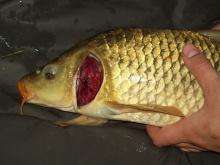
Common Carp with gill flap birth defect, a good visual example of gills. Image: Wikipedia.

(PhysOrg.com) -- A long-standing theory is that the first function of fish gills was to allow fish to breathe, but new research is casting doubt on the idea that this activity developed first.

A research team from the University of British Columbia in Canada studied the development of in the rainbow trout (Oncorhynchus mykiss) to find out which function of the gills appeared first: or ion exchange. Their experiments suggest that gills were involved in ion exchange first, which further suggests this might have been the first activity to evolve. The experiments provide the first direct physiological evidence to support what is known as the ionoregulatory .

The research team placed each larva in a type of compartmentalized plastic box called a flux chamber, which had one compartment for the head and gills, and another for the tail end, and then measured oxygen and ion levels ( and ) at both ends. By 15-16 days after hatching, the gills were exchanging more ions than the tail, but it took another 8-13 days before the gills were exchanging more oxygen. Ions (charged chemical particles) are necessary for the cells to function, but they can become toxic if their concentration in the blood is too high.

One of the researchers, Ms Clarice Fu, said that the pressures affecting larvae were similar to evolutionary pressures, which is why scientists often study the development of larvae to investigate evolution. She said that some of the pressures include an greater body size, more active lifestyle, and thicker skin. As the grew the pressures (such as the thickening skin) drove ion exchange to the gills before they started to use the gills for breathing, which Fu said indicates the same thing may have occurred during the evolution of the fish: those individuals with gills capable of ion exchange would have a better chance of survival than those that did not, or those that retained a thinner skin for ion uptake.

The research paper is published online in this week's edition of the Royal Society journal Proceedings B.

Explore further: Honeybees trained in Croatia to find land mines

More information: Ions first: Na+ uptake shifts from the skin to the gills before O2 uptake in developing rainbow trout, Oncorhynchus mykiss, Proceedings of the Royal Society B, doi:10.1098/rspb.2009.1545

Related Stories

The secretive immune system of the salmon

Jan 27, 2009

During his doctoral thesis, Erlend Haugarvoll discovered new aspects of the salmon immune system. His research looked at the immune cells in the gills of salmon and at immune responses to vaccination. A special ...

Something fishy in human blood could save lives

Mar 30, 2007

Thousands of people with liver and kidney disease die every year from too much ammonia in their blood, and scientists from the United States and Japan have found a possible solution. In the April 2007 issue of The FASEB Journal ...

Harmful 'red tide' hits Dubai beaches

Apr 07, 2009

Beaches in the Gulf tourism hub of Dubai have been plagued by a bloom of algae known as the "red tide" that has killed fish and is potentially harmful to humans, a municipality official said on Tuesday.

Recommended for you

Lovelorn frogs bag closest crooner

9 hours ago

What lures a lady frog to her lover? Good looks, the sound of his voice, the size of his pad or none of the above? After weighing up their options, female strawberry poison frogs (Oophaga pumilio) bag th ...

Honeybees trained in Croatia to find land mines

May 19, 2013

(AP)—Mirjana Filipovic is still haunted by the land mine blast that killed her boyfriend and blew off her left leg while on a fishing trip nearly a decade ago. It happened in a field that was supposedly ...

Front-row seats to climate change

May 17, 2013

By day, insects provide the white noise of the South, but the night belongs to the amphibians. In a typical year, the Southern air hangs heavy from the humidity and the sounds of wildlife.

User comments : 0

More news stories

Lovelorn frogs bag closest crooner

What lures a lady frog to her lover? Good looks, the sound of his voice, the size of his pad or none of the above? After weighing up their options, female strawberry poison frogs (Oophaga pumilio) bag th ...

Slow earthquakes: It's all in the rock mechanics

(Phys.org) —Earthquakes that last minutes rather than seconds are a relatively recent discovery, according to an international team of seismologists. Researchers have been aware of these slow earthquakes, ...

Computer model predicts when viruses become infectious

A new computer model could help scientists predict when a particular strain of avian influenza might become infectious from bird to human, according to a report to be published in the International Journal Data Mining an ...