Scientists create world's first molecular transistor
Dec 23, 2009
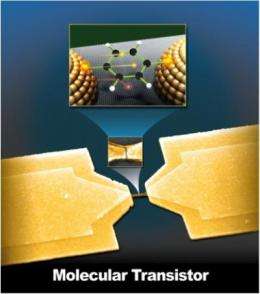
Engineers adjusted the voltage applied via gold contacts to a benzene molecule, allowing them to raise and lower the molecule’s energy states and demonstrate that it could be used exactly like a traditional transistor at the molecular level. Credit: Hyunwook Song and Takhee Lee

A group of scientists has succeeded in creating the first transistor made from a single molecule. The team, which includes researchers from Yale University and the Gwangju Institute of Science and Technology in South Korea, published their findings in the December 24 issue of the journal Nature.

The team, including Mark Reed, the Harold Hodgkinson Professor of Engineering & Applied Science at Yale, showed that a benzene molecule attached to gold contacts could behave just like a transistor.

The researchers were able to manipulate the molecule's different energy states depending on the voltage they applied to it through the contacts. By manipulating the energy states, they were able to control the current passing through the molecule.

"It's like rolling a ball up and over a hill, where the ball represents electrical current and the height of the hill represents the molecule's different energy states," Reed said. "We were able to adjust the height of the hill, allowing current to get through when it was low, and stopping the current when it was high." In this way, the team was able to use the molecule in much the same way as regular transistors are used.

The work builds on previous research Reed did in the 1990s, which demonstrated that individual molecules could be trapped between electrical contacts. Since then, he and Takhee Lee, a former Yale postdoctoral associate and now a professor at the Gwangju Institute of Science and Technology, developed additional techniques over the years that allowed them to "see" what was happening at the molecular level.

Being able to fabricate the electrical contacts on such small scales, identifying the ideal molecules to use, and figuring out where to place them and how to connect them to the contacts were also key components of the discovery. "There were a lot of technological advances and understanding we built up over many years to make this happen," Reed said.

There is a lot of interest in using molecules in computer circuits because traditional transistors are not feasible at such small scales. But Reed stressed that this is strictly a scientific breakthrough and that practical applications such as smaller and faster "molecular computers"—if possible at all—are many decades away.

"We're not about to create the next generation of integrated circuits," he said. "But after many years of work gearing up to this, we have fulfilled a decade-long quest and shown that molecules can act as transistors."

Explore further: Stacking 2-D materials produces surprising results

add to favorites email to friend print save as pdf

Related Stories

Theorist helps develop first single molecule transistor

Jun 07, 2005

A scientist at the University of Liverpool has helped to create the world's smallest transistor - by proving that a single molecule can power electric circuits Dr Werner Hofer, from the University's Surface Science Research ...

Michigan Tech Team Models Molecular Transistor

Aug 13, 2009

(PhysOrg.com) -- Electronic gadgetry gets tinier and more powerful all the time, but at some point, the transistors and myriad other component parts will get so little they won't work. That's because when ...

Memory in artificial atoms

Apr 07, 2008

Nanophysicists have made a discovery that can change the way we store data on our computers. This means that in the future we can store data much faster, and more accurate. Their discovery has been published in the scientific ...

Recommended for you

Stacking 2-D materials produces surprising results

May 16, 2013

(Phys.org) —Graphene has dazzled scientists, ever since its discovery more than a decade ago, with its unequalled electronic properties, its strength and its light weight. But one long-sought goal has proved ...

User comments : 2

Adjust slider to filter visible comments by rank

Display comments: newest first

RealScience
not rated yet Dec 24, 2009
Benzene may be the SMALLEST single-molecule that has been made into a transistor.

But single-walled carbon nanotubes are 'single molecules', and transistors have been made in single swCNTs before (Multiple transistors have even been made in a single carbon nanotube).
Bob_B
not rated yet Dec 26, 2009
What about the transistor made from a single atom? It was in the news just a few weeks ago.

More news stories

How nanotechnology could keep your heart healthy

Since the heart is such a delicate and critical organ, clinicians usually opt not to intervene with the dead cells that remain after a heart attack or cardiac disease. "But we think that all heart attacks deserve some kind ...

Graphene joins the race to redefine the ampere

A new joint innovation by the National Physical Laboratory (NPL) and the University of Cambridge could pave the way for redefining the ampere in terms of fundamental constants of physics. The world's first ...

Alaska volcano shoots ash 15,000 feet into the air

(AP)—One of Alaska's most restless volcanoes has shot an ash cloud 15,000 feet into the air in an ongoing eruption that has drawn attention from a nearby community but isn't expected to threaten air traffic.

US seizes Bitcoin operator accounts

US authorities seized the accounts of a Bitcoin digital currency exchange operator, claiming it was functioning as an "unlicensed money service business," court documents showed Friday.

Chinese, Indian airlines face EU pollution fines

Eight Chinese and two Indian airlines face fines of up to several million euros for not paying for their greenhouse gas emissions during flights within the bloc, the European Commission said on Friday.