Nanoparticles go platinum: NCEM instruments provide key images

Dec 21, 2009 by Lynn Yarris
This STEM image, obtained using NCEM’s Tecnai at a resolution of 0.14 nanometers, shows the platinum particles (white dots) and their locations on carbon nanotubes and DNA strands.

At Berkeley Lab's National Center for Electron Microscopy it was revealed that single-stranded DNA can disperse bundles of single-walled carbon nanotubes into individual tubes and serve as guideposts for synthesizing platinum nanoparticles onto these tubes.

Berkeley Lab’s National Center for Electron Microscopy (NCEM) provided the technology and a Visiting Scientist Fellowship that helped a Missouri State University researcher make a key discovery which should boost efforts to use carbon nanotubes as catalytic supports in direct ethanol fuel cells. Using the advanced characterization capabilities of NCEM’s TEAM 0.5 and Tecnai microscopes, materials scientist Lifeng Dong found that single-stranded DNA can be used to disperse bundles of single-walled carbon nanotubes into individual tubes. The single strands of DNA can also serve as guideposts for synthesizing platinum onto these tubes.

“Without the Visiting Scientist Fellowship from NCEM, I would not have had the opportunity to work with NCEM scientists and to use state-of-the-art microscopes to characterize those samples,” Dong wrote in a letter to NCEM director Uli Dahmen. Dong acquired his images at TEAM 0.5 and the 200 kV Tecnai with the help of Berkeley Lab staff at NCEM including Christian Kisielowski, Thomas Duden, Masashi Watanabe, Zonghoon Lee and ChengYu Song.
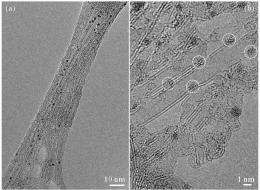
The TEM image in (a) shows platinum nanoparticles (black specks) on a bundle of single-walled carbon nanotubes. Under higher magnification in (b), the nanotubes start to separate from one another and the configuration of the platinum particles (dashed circles) along the nanotubes is revealed.

Portable fuel cells powered directly by ethanol have the potential to be far more efficient than ethanol-powered combustion engines and far more practical than hydrogen fuels cells, as ethanol is easier to store and transport than hydrogen. What’s been missing for the production of direct ethanol fuel cells is a good catalyst for oxidizing ethanol.

Platinum-coated single-walled carbon nanotubes (SWCNTs) show bright promise for this task because of their high electronic conductivity and surface area. However, it is the nature of these single-walled nanotubes to form bundles. For them to be effectively used as supporters of platinum catalysts in direct ethanol fuel cells, efficient ways must be found to separate bundled SWCNTs into individual tubes and to synthesize platinum nanoparticles on the nanotubes.

“Our images show that platinum nanoparticles selectively grow on carbon nanotubes in accordance with single-stranded DNA locations,” Dong says. “The DNA molecules not only effectively disperse SWCNT bundles into individual tubes, but also provide an address for the formation of nanoparticles along the nanotube surfaces. This suggests a method to synthesize other types of carbon nanotube-supported nanoparticles, such as palladium and gold, for applications in fuel cells and nanoscale electronics.”

The acronym TEAM stands for Transmission Electron Aberration-corrected Microscope. TEAM 0.5 is capable of producing images with a resolution of one-half angstrom, which is less than the diameter of a single hydrogen atom. TEAM 0.5 also has the ability to correct for the image-degrading phenomenon known as spherical aberration. The 200kV Tecnai microscope is optimized for materials research that requires either the highest resolution scanning transmission performance, meaning imaging and spectroscopy, or correlated imaging and analytical methods.

“The biggest challenge for obtaining these images was that our microscopes remain stable at their top performance levels,” says NCEM staff member Song, who provides support for the 200 kV Tecnai microscope. “As we image a sample at the atomic scale, any instability in the microscope is magnified millions of times with the image. At NCEM we routinely check the performances of our microscopes and look after any optical, mechanical, or electrical disturbances.”

Explore further: 3D printing tiny batteries

add to favorites email to friend print save as pdf

Related Stories

Carbon Nanotubes Make Fuel Cells Cheaper

Feb 09, 2009

(PhysOrg.com) -- As fuel cells are becoming more popular due to their potential use in applications such as hydrogen-powered vehicles, auxiliary power systems, and electronic devices, the need for the precious ...

Cells selectively absorb short nanotubes

Mar 30, 2007

DNA-wrapped single-walled carbon nanotubes (SWCNTs) shorter than about 200 nanometers readily enter into human lung cells and so may pose an increased risk to health, according to scientists at the National ...

A recipe for controlling carbon nanotubes

Sep 20, 2009

Nanoscopic tubes made of a lattice of carbon just a single atom deep hold promise for delivering medicines directly to a tumor, sensors so keen they detect the arrival or departure of a single electron, a replacement for ...

TEAM Project Achieves Microscopy Breakthrough

Sep 06, 2007

The highest-resolution images ever seen in (S)TEM electron microscopy have been recorded using a new instrument developed jointly by U.S. Department of Energy national laboratories, FEI Company and CEOS GmbH, in Heidelberg, ...

A Search for Stability for Platinum Catalysts

Dec 17, 2009

(PhysOrg.com) -- A new carbon support that greatly increases the durability of proton-exchange membrane fuel cells has been developed by scientists at Pacific Northwest National Laboratory and Princeton University. ...

Recommended for you

3D printing tiny batteries

16 hours ago

(Phys.org) —3D printing can now be used to print lithium-ion microbatteries the size of a grain of sand. The printed microbatteries could supply electricity to tiny devices in fields from medicine to communications, ...

World's most powerful microscope ready for research

21 hours ago

(Phys.org) —The world's most powerful microscope, which resides in a specially constructed room at the University of Victoria, has now been fully assembled and tested, and has a lineup of scientists and businesses eager ...

Future looks bright for carbon nanotube solar cells

21 hours ago

(Phys.org) —In an approach that could challenge silicon as the predominant photovoltaic cell material, University of Wisconsin-Madison materials engineers have developed an inexpensive solar cell that exploits ...

A breakthrough in plasmonics

Jun 17, 2013

EPFL scientists have discovered how optical signal transmission can be controlled, paving the way for the integration of plasmonics with conventional electronic circuits.

User comments : 0

More news stories

3D printing tiny batteries

(Phys.org) —3D printing can now be used to print lithium-ion microbatteries the size of a grain of sand. The printed microbatteries could supply electricity to tiny devices in fields from medicine to communications, ...

Future looks bright for carbon nanotube solar cells

(Phys.org) —In an approach that could challenge silicon as the predominant photovoltaic cell material, University of Wisconsin-Madison materials engineers have developed an inexpensive solar cell that exploits ...

Hybrid material as gold-leaf substitute

(Phys.org) —A team of researchers headed by Professor Raffaele Mezzenga has created a hybrid material out of gold and milk proteins that looks like a wafer-thin gold leaf. Thanks to its properties, it could ...

World's most powerful microscope ready for research

(Phys.org) —The world's most powerful microscope, which resides in a specially constructed room at the University of Victoria, has now been fully assembled and tested, and has a lineup of scientists and businesses eager ...

Dish won't submit revised bid for Sprint

Satellite TV operator Dish Network Corp. said Tuesday it would not submit a revised bid for Sprint, leaving the path open for the wireless carrier to accept what it already considers a superior offer from Japan's Softbank.

Cape Wind gets $200M investment from Danish fund

The Cape Wind offshore wind project has secured a $200 million investment from a Danish pension fund in what the wind farm's president said Tuesday is a milestone for the long-delayed project.