Scientists crack gene code of common cancers
Dec 17, 2009
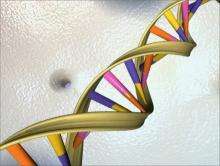
This undated illustration shows the DNA double helix. Two common forms of cancer, skin and lung cancer, have been genetically mapped for the first time, British scientists announced, in a major breakthrough in understanding the diseases.

Two common forms of cancer have been genetically mapped for the first time, British scientists announced, in a major breakthrough in understanding the diseases.

The maps have exposed the that lead to skin and lung cancers, in a discovery scientists said could transform the way these diseases are diagnosed and treated in coming years.

All cancers are caused by damage to genes -- mutations in DNA -- that can be triggered by environmental factors such as tobacco smoke, harmful chemicals or ultraviolet radiation, and causes cells to grow out of control.

Scientists from Britain's Wellcome Trust Sanger Institute and their collaborators have mapped this from the tumours of two patients suffering from lung cancer and malignant melanoma, a deadly skin cancer.

"This is a fundamental moment in cancer research. From here on in we will think about cancers in a very different way," said Professor Mike Stratton who led the institute's cancer genome project.

"Today for the first time, in two individual cancers, a melanoma and a lung cancer, we have provided the complete list of abnormalities in DNA in each of those two cancers," he told the BBC.

"We now see uncovered all the forces that have generated that cancer and we now see all the genes that are responsible for driving those two cancers."

The scientists' research, published in the journal Nature, also gained deeper insights into the way the body tries to repair the damage caused by the cancers and stop the disease spreading.

Stratton said the research could in future change the way cancers are treated -- by using genetic maps to find the defects that caused them.

"Now that we have these comprehensive complete catalogues of mutations on individual cancers, we will be able to see how each cancer developed, what were the exposures, what were the environmental factors and that's going to be key for our understanding generally of how cancers develop," he said.

"And for our individual patients, we will see all the genes that are abnormal and are driving each cancer and that's really critical, because that will tell us which drugs are likely to have an effect on that particular cancer and which are not."

Peter Campbell, a cancer-genomics expert involved in the research, said the number of mutations discovered -- 33,345 for melanoma -- and 22,910 for -- was remarkable.

"It is amazing what you can see in these genomes," he said on the website of the .

The research shows most mutations could be traced to the effects of chemicals in (in the lung tumour) or ultraviolet light (in the melanoma tumour), supporting the idea that they are largely preventable.

"Every pack of cigarettes is like a game of Russian roulette," he said.

"Most of those mutations will land where nothing happens in the genome and won't do major damage, but every once in a while they'll hit a gene."

Explore further: New smartphone application improves colonoscopy preparation

add to favorites email to friend print save as pdf

Related Stories

Largest genome study of cancer types finds many mutations

Mar 07, 2007

Scientists at the Wellcome Trust Sanger Institute, where one-third of the human genome was sequenced, have now pioneered decoding the sequence of cancer genomes. They have carried out the broadest survey yet of the human ...

Connecting cancer genes

May 15, 2008

A large genetic study in mice has identified hundreds of genes involved in the development of cancer by examining the DNA of more than 500 lymphomas to find the cancer causing mutations.

Recommended for you

New smartphone application improves colonoscopy preparation

23 hours ago

The use of a smartphone application significantly improves patients' preparation for a colonoscopy, according to new research presented today at Digestive Disease Week (DDW). The preparation process, which begins days in ...

New colonoscope provides ground-breaking view of colon

May 18, 2013

A ground-breaking advance in colonoscopy technology signals the future of colorectal care, according to research presented today at Digestive Disease Week(DDW). Additional research focuses on optimizing the minimal withdrawal ...

ASCO: combo antibody therapy effective for melanoma

May 17, 2013

(HealthDay)—Concurrent use of two immune checkpoint antibodies—ipilimumab and nivolumab—may be effective for the treatment of advanced melanoma, according to a proof-of-principal study presented in ...

Risk factors ID'd for poor cutaneous cell CA outcomes

May 17, 2013

(HealthDay)—The risks of metastasis and death associated with cutaneous squamous cell carcinoma (CSCC) are low, but significant, and risk factors for poor outcome include tumor diameter, invasion beyond ...

User comments : 2

Adjust slider to filter visible comments by rank

Display comments: newest first

whygreen
not rated yet Dec 17, 2009
25 years ago I was blacklisted by the U of Waterloo so they could commit federal fraud even though I had the support of a leading scientist from M.D.Anderson Cancer Center. I proposed the Cell Death Signal Gene theory. It is this sequence that the mapped mutations bypass so the cancers can grow.A former US Surgeon Gen. has regretted my treatment. Hope it won't take another 25 years to map this sequence.Ask yourselves in the last 25 years how many died of cancer that didn't have to? Anyone you loved?
fixer
not rated yet Dec 18, 2009
Fascinating, but it includes the word "could" too many times.
Sounds like a plea for more funds to me as it doesen't actually say anything useful from a patients point of view.
If it is available in 5 years like most of these ads (posts) then any patient reading it will be dead before it is available, which it won't be as we seem to get about 3 major revelations a day reported at the moment.

More news stories

Heat-related deaths in Manhattan projected to rise

Residents of Manhattan will not just sweat harder from rising temperatures in the future, says a new study; many may die. Researchers say deaths linked to warming climate may rise some 20 percent by the 2020s, ...

Honeybees trained in Croatia to find land mines

(AP)—Mirjana Filipovic is still haunted by the land mine blast that killed her boyfriend and blew off her left leg while on a fishing trip nearly a decade ago. It happened in a field that was supposedly ...

Mice, gerbils perish in Russia space flight

A number of mice and eight gerbils sent into space in a Russian capsule destined to find out how well organisms can withstand extended flights perished during their journey, scientists said Sunday as the ...