ISS astronauts land safely in Kazakhstan
Dec 01, 2009
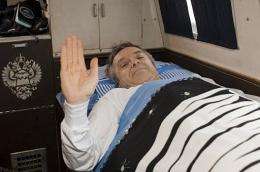
Canadian astronaut Robert Thirsk rests in a vehicle after he returned to earth from the International Space Station (ISS) aboard a Soyuz TMA-15 space capsule that landed around 88 kms (55 miles) north of the town of Arkalyk, in northern Kazakhstan.

A space capsule carrying a Belgian, a Canadian and a Russian landed safely in the steppes of Kazakhstan on Tuesday after the trio spent half a year on the International Space Station (ISS).

Belgian Frank De Winne, Canadian Robert Thirsk and Russian Roman Romanenko landed at 10:16 am (0716 GMT) around 88 kilometres (55 miles) north of Arkalyk, a town in central Kazakhstan, a spokeswoman for Russian mission control said.

Television pictures showed the astronauts being pulled from the Soyuz TMA-15 capsule and put onto stretchers by Russian cosmonaut-retrieval crews.

De Winne -- the first European to command the ISS -- waved to the television camera as he was loaded onto a stretcher.

Astronauts have trouble walking when they return to Earth after long stays in zero gravity.

Freezing weather and low clouds forced the cosmonaut-retrieval crews to head to the landing scene in all-terrain vehicles rather than the usual helicopters, space officials said.

"They feel good.... I congratulate everyone. The main thing is they are all alive and well," Anatoly Perminov, head of the Russian federal space agency, told a televised news conference after the landing.

Steve MacLean, head of the Canadian space agency, called the trio's space voyage an "amazing adventure."

"On behalf of the Canadian space agency and on behalf of Canada I want to congratulate the crew," MacLean told reporters.

"This was a mission of international partnership and I think history will show this is how we will work in the future," he added.

De Winne, Thirsk and Romanenko had been in space more than six months, arriving at the ISS on May 29.

Romanenko, 38, was making his first flight into space and following in the footsteps of his father, Yury Romanenko, a veteran Soviet cosmonaut who made a number of spaceflights in the 1970s and 1980s.

The three had originally been scheduled to be transported to the Star City cosmonaut training centre outside Moscow on Tuesday to be reunited with their families and to continue re-adjusting to gravity.

However the bad weather delayed their departure until at least Wednesday, meaning they would spend the night in Kazakhstan, officials said.

The ISS will be manned by just two people, US astronaut Jeff Williams and Russian cosmonaut Maxim Surayev, until late December, when three more crew members are set to arrive.

(c) 2009 AFP

Explore further: Field tests in Mojave Desert pave way for human exploration of small bodies

add to favorites email to friend print save as pdf

Related Stories

New dinner table top priority as ISS expands

May 07, 2009

Astronauts set to blast off for the International Space Station said Thursday that constructing a new dinner table would be a top priority as its permanent crew expands to six.

Astronauts blast off to double space station crew

May 27, 2009

Three astronauts, from Canada, Belgium and Russia, blasted off Wednesday for the International Space Station in a landmark mission that will double its crew to six for the first time.

Russian cargo spacecraft nearing ISS

Jun 17, 2005

MOSCOW, June 17 (UPI) -- A Russian cargo spacecraft has been launched into orbit successfully and will reach the International Space Station Saturday, Russian space officials said.

Recommended for you

Mice, gerbils perish in Russia space flight

6 hours ago

A number of mice and eight gerbils sent into space in a Russian capsule destined to find out how well organisms can withstand extended flights perished during their journey, scientists said Sunday as the ...

Mars rover Opportunity examines clay clues in rock

May 18, 2013

(Phys.org) —NASA's senior Mars rover, Opportunity, is driving to a new study area after a dramatic finish to 20 months on "Cape York" with examination of a rock intensely altered by water.

NASA's STEREO detects a CME from the sun

May 17, 2013

On 5:24 a.m. EDT on May 17, 2013, the sun erupted with an Earth-directed coronal mass ejection or CME, a solar phenomenon that can send billions of tons of solar particles into space that can reach Earth ...

Nine-year-old Mars rover passes 40-year-old record

May 17, 2013

While Apollo 17 astronauts Eugene Cernan and Harrison Schmitt visited Earth's moon for three days in December 1972, they drove their mission's Lunar Roving Vehicle 19.3 nautical miles (22.210 statute miles ...

Bright explosion on the Moon

May 17, 2013

For the past 8 years, NASA astronomers have been monitoring the Moon for signs of explosions caused by meteoroids hitting the lunar surface. "Lunar meteor showers" have turned out to be more common than anyone ...

User comments : 0

More news stories

Bold action, big money needed to curb Asia floods

Asia's flood-prone megacities should fund major drainage, water recycling and waste reduction projects to stem deluges and secure clean supply for their booming populations, experts said Sunday.

Heat-related deaths in Manhattan projected to rise

Residents of Manhattan will not just sweat harder from rising temperatures in the future, says a new study; many may die. Researchers say deaths linked to warming climate may rise some 20 percent by the 2020s, ...

Mice, gerbils perish in Russia space flight

A number of mice and eight gerbils sent into space in a Russian capsule destined to find out how well organisms can withstand extended flights perished during their journey, scientists said Sunday as the ...