Implant-based cancer vaccine is first to eliminate tumors in mice
Nov 25, 2009
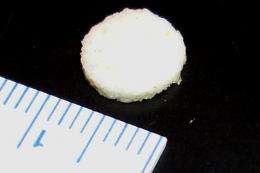
A polymer implant, 8.5 mm in diameter, is embedded with chemical signals that encourage immune cells to attack tumors. Photo: Omar Ali/Harvard University

(PhysOrg.com) -- A cancer vaccine carried into the body on a carefully engineered, fingernail-sized implant is the first to successfully eliminate tumors in mammals, scientists report this week in the journal Science Translational Medicine.

The new approach, pioneered by bioengineers and immunologists at Harvard University, uses plastic disks impregnated with tumor-specific antigens and implanted under the skin to reprogram the mammalian immune system to attack tumors. The new paper describes the use of such implants to eradicate melanoma tumors in mice.

"This work shows the power of applying engineering approaches to immunology," says David J. Mooney, the Robert P. Pinkas Family Professor of Bioengineering in Harvard's School of Engineering and Applied Sciences and Wyss Institute for Biologically Inspired Engineering. "By marrying engineering and immunology through this collaboration with Glenn Dranoff at the Dana-Farber Institute, we've taken a major step toward the design of effective cancer vaccines."

Most easily skirt the immune system, which operates by recognizing and attacking invaders from outside the body. The approach developed by Mooney's group redirects the immune system to target tumors, and appears both more effective and less cumbersome than other cancer vaccines currently in clinical trials.

Conventional cancer vaccinations remove immune cells from the body, reprogram them to attack malignant tissues, and return them to the body. However, more than 90 percent of reinjected cells have died before having any effect in experiments.

The slender implants developed by Mooney's group are 8.5 millimeters in diameter and made of an FDA-approved biodegradable polymer. Ninety percent air, the disks are highly permeable to immune cells and release cytokines, powerful recruiters of immune-system messengers called dendritic cells.

These cells enter an implant's pores, where they are exposed to specific to the type of tumor being targeted. The dendritic cells then report to nearby lymph nodes, where they direct the immune system's T cells to hunt down and kill tumor cells.

"Inserted anywhere under the skin -- much like the implantable contraceptives that can be placed in a woman's arm -- the implants activate an immune response that destroys tumor cells," Mooney says.

The technique may have powerful advantages over surgery and chemotherapy, and may also be useful in combination with existing therapies. It only targets tumor cells, avoiding collateral damage elsewhere in the body. And, much as an immune response to a bacterium or virus generates long-term resistance, researchers anticipate cancer vaccines will generate permanent and body-wide resistance against cancerous cells, providing durable protection against relapse.

Mooney says the new approach's strength lies in its ability to simultaneously regulate the two arms of the human immune system: one that destroys foreign material and one that protects tissue native to the human body. The implant-based vaccine recruits several types of that direct destructive immune responses, creating an especially potent anti-tumor response.

"This approach is able to simultaneously upregulate the destructive immune response to the tumor while downregulating the arm of the that leads to tolerance," Mooney says. "In cancer, this latter arm is typically a limiting feature of immunotherapies, since it can extinguish vaccine activity and afford tumors a degree of protection."

Source: Harvard University (news : web)

Explore further: New smartphone application improves colonoscopy preparation

add to favorites email to friend print save as pdf

Related Stories

Researchers discover novel way to develop tumor vaccines

Mar 02, 2008

Researchers at the University of Southern California (USC) have uncovered a new way to develop more effective tumor vaccines by turning off the suppression function of regulatory T cells. The results of the study, titled ...

Study: Tumors inhibit immune system

May 29, 2006

Seattle scientists have shown that tumors can manipulate the immune system to stop it from attacking cancer cells, said a study published in Nature Immunology.

Tumor wizardry wards off attacks from the immune system

Jul 14, 2006

Like the fictional wizard Harry Potter, some cancerous tumors seem capable of wrapping themselves in an invisibility cloak. Researchers at Washington University School of Medicine in St. Louis have found that pancreatic tumors ...

Researchers one step closer to elusive cancer vaccine

Oct 29, 2007

When cells become cancerous, the sugars on their surfaces undergo distinct changes that set them apart from healthy cells. For decades, scientists have tried to exploit these differences by training the immune system to attack ...

Recommended for you

New smartphone application improves colonoscopy preparation

18 hours ago

The use of a smartphone application significantly improves patients' preparation for a colonoscopy, according to new research presented today at Digestive Disease Week (DDW). The preparation process, which begins days in ...

New colonoscope provides ground-breaking view of colon

May 18, 2013

A ground-breaking advance in colonoscopy technology signals the future of colorectal care, according to research presented today at Digestive Disease Week(DDW). Additional research focuses on optimizing the minimal withdrawal ...

ASCO: combo antibody therapy effective for melanoma

May 17, 2013

(HealthDay)—Concurrent use of two immune checkpoint antibodies—ipilimumab and nivolumab—may be effective for the treatment of advanced melanoma, according to a proof-of-principal study presented in ...

Risk factors ID'd for poor cutaneous cell CA outcomes

May 17, 2013

(HealthDay)—The risks of metastasis and death associated with cutaneous squamous cell carcinoma (CSCC) are low, but significant, and risk factors for poor outcome include tumor diameter, invasion beyond ...

User comments : 7

Adjust slider to filter visible comments by rank

Display comments: newest first

mdr
5 / 5 (1) Nov 25, 2009
I wonder how much we'll have to pay the patent holder and the doctors to have these installed once they finish getting them sorted and through clinical trials. They should be pretty cheap as far as materials and assembly, but I'm sure they'll want to have a hefty markup. Still, it should be cheaper than chemo and surgery. I'll definitely get one as soon as they work out a universal version for most cancers (if this one isn't already, anyone know if they are working on studies for other cancers with it yet?). It's not clear if it only works on melanomas, or if that's just the only type of tumor they used in the study. Do they know what antigens to use for other types of tumors, or do those still have to be discovered..
gmurphy
5 / 5 (1) Nov 25, 2009
outstanding work, but it must be reproduced elsewhere and preferably in other types of cancer before significant conclusions can be drawn. Every few months or so on phsyorg there's an example of an amazing cancer cure/result which works for a specific cancer in engineered mice but fails to persist beyond that result. Either way, another weapon in the arsnel against cancer is welcomed into the fray
fixer
1 / 5 (1) Nov 25, 2009
The immune system of mice is markedly different from human, hence most murine specific drugs fail.
Since Artemisinin was released for cancer therapy I have yet to read of any better treatment.
"Curing cancer" requires two discrete therapies, firstly removing the tumor mass, then modifying the immune system to prevent it reoccuring.
Artemisinin removes cancer by using the laws of physics rather than the speculation of medicine,
and there are now several protocols for modifying and repairing the immune system.
Both therapies using established drugs with no or minimal side effects but unknown to oncologists.
A google search will provide all the necessory info.
dirk_bruere
5 / 5 (1) Nov 26, 2009
Does this target all tumors or only specific types?
joefarah
not rated yet Nov 26, 2009
Please read the article. It clearly says, twice, tumor-specific, not all tumors.
antialias
not rated yet Nov 26, 2009
I think the major advantage over surgery and chemo/radiation therapy is that this could possibly affect tumors which have already spread.

While the mouse's immune system is not identical to the human one there are good mouse models for specific diseases and specific disease-immune system interactions. The value of this study is not to develop a drug that will work on humans just like on mice but a METHOD that could - suitably altered - provide a very effective way of treating some tumors.
fixer
1 / 5 (1) Nov 26, 2009
Well and good, Incidently, Artemisinin is now proven effective on 55 cancer lines, and is held back only by social inertia.
How many times do we have to read of theoretical treatments which may be available in a few years?
You don't die of cancer anymore, you die of ignorance.

More news stories

Heat-related deaths in Manhattan projected to rise

Residents of Manhattan will not just sweat harder from rising temperatures in the future, says a new study; many may die. Researchers say deaths linked to warming climate may rise some 20 percent by the 2020s, ...

Kinks and curves at the nanoscale

One of the basic principles of nanotechnology is that when you make things extremely small—one nanometer is about five atoms wide, 100,000 times smaller than the diameter of a human hair—they are going ...