US gets a 'D' for preterm birth rate
Nov 17, 2009
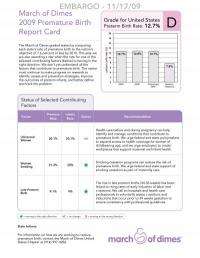
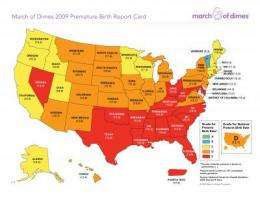
The US again earned a "D" on the second annual Premature Birth Report Card. No State earned an "A," and only Vermont earned a "B." Credit: March of Dimes Foundation

For the second consecutive year, the United States earned only a "D" on the March of Dimes Premature Birth Report Card, demonstrating that more than half a million of our nation's newborns didn't get the healthy start they deserved.

In the 2009 Report card, seven states improved their performance by one letter grade and two fared worse. Criteria that affect improved in many states:

  • 33 states and the District of Columbia reduced the percentage of women of childbearing age who smoke;
  • 21 states and the District of Columbia reduced the percent of uninsured women of childbearing age;
  • 27 states, the District of Columbia, and Puerto Rico lowered the late preterm birth rate.
As in 2008, no state earned an "A," and only Vermont received a "B." The grades were determined by comparing preterm birth rates to the national Healthy People 2010 preterm birth objective, which is 7.6 percent of all live births. The U.S. preliminary preterm birth rate was 12.7 percent in 2007.

"Although we don't yet understand all the factors that contribute to premature birth, we do know some interventions that can help prevent it, and we must consistently make use of all of these," said Dr. Jennifer L. Howse, President of the March of Dimes. She cited programs; health care before and during pregnancy; progesterone supplementation; and improved adherence to professional guidelines on fertility treatment and early Cesarean-sections and inductions.

According to the March of Dimes, quality improvement programs also are key to lowering preterm birth rates. For example, the Intermountain Health Program in Utah reduced its elective C-sections to less than 5 percent from more than 30 percent. At Geisinger Health System in Pennsylvania, pregnant women are screened for chronic conditions and risks factors that can be treated proactively to lower the risk of preterm birth.

A program run by the Hospital Corporation of America based in Tennessee, which delivers about 5 percent of all U.S. births in the 21 states it serves, reduced the primary C-section rate, lowered maternal and fetal injuries and reduced the cost of obstetric malpractice claims by 500 percent. Also, Parkland Memorial Hospital in Texas reduced its preterm birth rate to 4.9 percent in 2006 from 10.4 percent in 1988 by establishing a comprehensive, community-based public health care system of prenatal care that targets minority pregnant .

For the second consecutive year, the United States earned only a "D" on the March of Dimes Premature Birth Report Card, demonstrating that more than half a million of our nation's newborns didn't get the healthy start they deserved. Credit: March of Dimes Foundation

In the United States, more than 540,000 babies are born too soon each year. Preterm birth is a serious health problem that costs the United States more than $26 billion annually, according to the Institute of Medicine. It is the leading cause of newborn death, and babies who survive an early birth often face the risk of lifetime health challenges, such as breathing problems, cerebral palsy, mental retardation and others.

A March of Dimes report released in October found that 13 million babies worldwide were born preterm, and more than one million die each year.

The March of Dimes released its second annual report card today, the 7th Annual Prematurity Awareness Day, when the March of Dimes focuses the nation's attention on the growing problem of premature birth (birth before 37 weeks gestation). A special Web site - marchofdimes.com/fightforpreemies - includes state profiles on prematurity and ways for volunteers to help reduce the premature rate.

Source: March of Dimes Foundation (news : web)

Explore further: Aid group urges Spain to scrap 'dangerous' healthcare reform

add to favorites email to friend print save as pdf

Related Stories

Preterm birth rate drops

Mar 18, 2009

The nation's preterm birth rate declined slightly in 2007 - a finding that the March of Dimes hopes will prove to be the start of a new trend in improved maternal and infant health.

Preterm births rise 36 percent since early 1980s

Jan 07, 2009

New government statistics confirm that the decades-long rise in the United States preterm birth rate continues, putting more infants than ever at increased risk of death and disability.

More babies born prematurely, new report shows

Dec 06, 2007

The preterm birth rate rose again in 2005 and preliminary data for 2006 show a continued increase, underscoring the urgent need for a sustained, comprehensive plan to address this growing crisis.

Nearly 28,000 US infants died in 2004

May 04, 2007

Preterm birth contributes to more than one-third of all infant deaths, according to the National Vital Statistics report released today.

Recommended for you

New rule proposes insurance program integrity guidelines

10 hours ago

(HealthDay)—A new proposed rule, which provides program integrity guidelines for Affordable Insurance Exchanges, or Health Insurance Marketplaces (Marketplaces), has been released by the U.S. Department ...

EHR implementation first step toward quality improvement

15 hours ago

(HealthDay)—Implementation of electronic health records (EHRs) is a first step toward quality improvement and should be accompanied by use of new payment models to allow physicians to see a return on their ...

Why are some college students more likely to 'hook up'?

15 hours ago

Casual, no-strings sexual encounters are increasingly common on college campuses, but are some students more likely than others to "hook up"? A new study by researchers with The Miriam Hospital's Centers for Behavioral and ...

User comments : 0

More news stories

Panic over MERS virus fades in Saudi

People in Saudi Arabia's Eastern Province have again started greeting friends with the traditional kiss on the cheek, and face masks in public are becoming rarer, as panic subsides over the outbreak of a deadly respiratory ...

French firemen test hypnosis to help victims

"Look me straight in the eye. Your mind is emptying, your body is relaxing," says the fireman, using the calming words of hypnosis to help a trauma victim—a technique being pioneered by fire crews in the eastern French ...

S.Korean airlines ban shark fin as cargo

South Korea's two largest airlines, Korean Air and Asiana, said Thursday they had both decided to ban shark fin from their cargo flights as part of a growing global campaign against the Asian delicacy.

AP buys stake in live video service Bambuser

The Associated Press said Thursday that it has bought a minority stake in the live video service Bambuser, boosting its ability to acquire and distribute video collected by people who have witnessed news events.

UNESCO warns Syrian heritage sites endangered

UNESCO on Thursday added six ancient sites in Syria including a fortress of Saladin and a Crusader castle to the endangered World Heritage list, warning that more than two years of civil war had inflicted ...

Philippines financial capital bans plastic bags

The Philippines financial capital banned disposable plastic shopping bags and styrofoam food containers on Thursday, as part of escalating efforts across the nation's capital to curb rubbish that exacerbates ...