Penguins and sea lions help produce new atlas
Nov 16, 2009
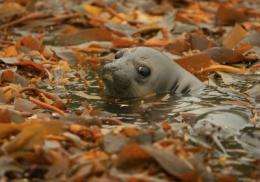
Southern elephant seals were fitted with GPS collars to help provide data for the new atlas. Credit: Valeria Falabella?Wildlife Conservation Society

Recording hundreds of thousands of individual uplinks from satellite transmitters fitted on penguins, albatrosses, sea lions, and other marine animals, the Wildlife Conservation Society (WCS) and BirdLife International have released the first-ever atlas of the Patagonian Sea - a globally important but poorly understood South American marine ecosystem.

The atlas contains the most accurate maps ever assembled for this ecosystem revealing key migratory corridors that span from coastlines to deep-sea feeding areas off the continental shelf hundreds of miles away.

Data for the atlas was gathered by a team of 25 scientists working over a 10-year period - many of them supported by the National Research Council of Argentina (CONICET). The team tracked 16 species of , which produced some 280,000 individual uplinks of data over the Patagonian Sea, a huge area ranging from southern Brazil to southern Chile.

Called Atlas of the Patagonian Sea: Species and Spaces, the 300-page book was edited by Valeria Falabella and Claudio Campagna of the Wildlife Conservation Society, and John Croxall of Birdlife International.

The atlas, which is in English and Spanish, will be used to help inform potential policy decisions in the region such as managing fisheries and charting transportation routes of oil tankers. This vast region, which spans 3 million square kilometers (1.1 million square miles), is becoming increasingly threatened by burgeoning development and overfishing.

"This unprecedented atlas was essentially written by the wildlife that live in the Patagonian Sea," said Dr. Claudio Campagna who runs the Wildlife Conservation Society's "Sea and Sky" initiative. "The atlas helps fill in many gaps of knowledge and should serve as a blueprint for future conservation efforts in this region."

"This is an exceptional collaborative achievement; now that we know where some of the region's most important marine areas are, they need to receive appropriate protection and management," said John Croxall, Chair of BirdLife's Global Seabird Programme.

The atlas underscores the need to establish a new network of marine protected areas that would include open-sea environments that are linked to key coastal areas. Many of the species tracked travel vast distances between coastal breeding grounds and feeding areas. For example, satellite data revealed that southern elephant seals travel more than 10,000 kilometers (6,200 miles) during an average season at sea, and an additional 10,000 kilometers in repeated vertical dives for food.

"The Patagonian Sea is a remarkable intersection of global physics, marine biodiversity, and climate and economic change," said Dr. Steven E. Sanderson, President and CEO of the Wildlife Conservation Society. "The Atlas of the Patagonian Sea will advance conservation of this region and can serve as a roadmap for the creation and management of future marine protected areas - of which there are precious few worldwide."

The list of species tracked for the atlas includes five species of albatross, three species of petrel, four varieties of penguin, two fur seal species, the South American sea lion, and the southern elephant seal.

The completion of the Atlas of the Patagonian Sea is due in large part to the generosity and long-standing support of the Liz Claiborne and Art Ortenberg Foundation for the WCS "Sea and Sky" initiative. Additionally, WCS's conservation work in this region has been supported by the Mitsubishi Foundation for the Americas and Mr. and Mrs. James M. Large, Jr.

Source: Wildlife Conservation Society (news : web)

Explore further: Coccoliths thrive despite ocean acidification

add to favorites email to friend print save as pdf

Related Stories

A happy new year for penguins

Dec 31, 2008

The Bronx Zoo-based Wildlife Conservation Society announced today that its efforts to protect a wildlife-rich coastal region in South America have paid off in the form of a new coastal marine park recently ...

Penguins march into new park

Aug 09, 2007

The Bronx Zoo-based Wildlife Conservation Society announced today that the government of Argentina will create a new marine park along its isolated and windswept Patagonia coast to safeguard more than half ...

Turtles are loyal in feeding as well as in breeding

Apr 25, 2007

A research team led by the Dr Annette Broderick of the University of Exeter’s School of Biosciences has discovered that, after laying their eggs, sea turtles travel hundreds of miles to feed at exactly the same sites. The ...

Penguins marching into trouble

Feb 12, 2009

A quarter-century of data reveals how changing weather patterns and land use, combined with overfishing and pollution, are taking a heavy toll on penguin numbers.

Recommended for you

Drought makes Borneo's trees flower at the same time

22 hours ago

Tropical plants flower at supra-annual irregular intervals. In addition, mass flowering is typical for the tropical forests in Borneo and elsewhere, where hundreds of different plant timber species from the ...

Coccoliths thrive despite ocean acidification

May 22, 2013

Ocean acidification is damaging some marine species while others thrive, say scientists. An international team studied the effect of ocean acidification on plankton in the North Sea over the past forty years, ...

Australia set to cull 10,000 wild horses

May 22, 2013

A controversial cull of up to 10,000 wild horses in Australia's harsh Outback reportedly began Wednesday in a bid to control the feral animals which officials say are destroying the land.

Encouraging signs for bee biodiversity

May 21, 2013

Declines in the biodiversity of pollinating insects and wild plants have slowed in recent years, according to a new study. Researchers led by the University of Leeds and the Naturalis Biodiversity Centre in the Netherlands ...

User comments : 0

More news stories

Unlocking secrets of cell reproduction

Research published in Open Biology today identifies, for the first time, nearly all the genes required for reproduction of a cell in a living organism.

Scientists announce Top 10 New Species from 2012

An amazing glow-in-the-dark cockroach, a harp-shaped carnivorous sponge and the smallest vertebrate on Earth are just three of the newly discovered top 10 species selected by the International Institute for ...

US teen birth rate drops to record low

US teen births have dropped to a record low, but the country still has one of the highest rates among developed nations, the US Centers for Disease Control and Prevention said Thursday.

Very Large Telescope celebrates 15 years of success

(Phys.org) —With this new view of a spectacular stellar nursery ESO is celebrating 15 years of the Very Large Telescope—the world's most advanced optical instrument. This picture reveals thick clumps ...

US House sends message on Keystone pipeline

US lawmakers agreed to a bill that would speed construction of a Canada-US oil pipeline and circumvent the need for President Barack Obama's approval for the $5 billion project.

Be prepared for weather extremes

Unsettled weather is an Iowa mainstay, and so is Inside's annual reminder of the university's severe weather safety and preparedness guidelines—for storms, extreme heat, flooding and more.