Cyclone Phyan raining on Tibet after breaking a record in India
Nov 13, 2009
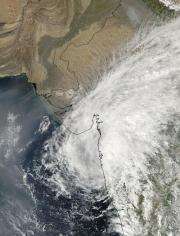
NASA's MODIS instrument on the Aqua satellite captured this stunning visual image of Tropical Cyclone Phyan making landfall north of Mumbai on Nov. 11 at 0845 UTC (3:45 ET). Credit: MODIS Rapid Response Team

Cyclone Phyan broke a 43 year record when it made landfall north of the city of Mumbai, India during the evening hours on November 11. NASA's Aqua satellite captured Phyan's landfall with one instrument, and a day later, another of Aqua's instruments show the storm's remnants raining Tibet as Phyan continues to dissipate.

Phyan is the first tropical cyclone to make an appearance in November in the Konkan region of India since 1996. The India Meteorological Department confirmed that the last November appearance of a storm in that region was 43 years ago. As Phyan was making landfall, NASA's Aqua satellite passed overhead, and the Moderate Imaging Spectroradiometer captured a stunning visual image of the storm on November 11 at 0845 UTC (3:45 ET).

On November 12 at 1:30 p.m. local time (2:30 a.m. ET) another instrument on Aqua called the Atmospheric Infrared Sounder (AIRS) captured an image of Phyan's remnant cold clouds and showers over Tibet. The AIRS image showed that Phyan still had cold cloud tops as cold as -27F and was dumping moderate rainfall over Lake Manasarovar and Raksas Tal in Tibet.
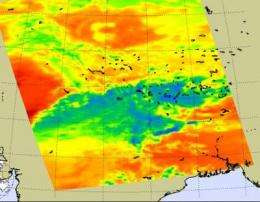
NASA's Aqua satellite AIRS instrument captured an infrared image of Cyclone Phyan's remnants over Tibet on Nov. 12. At that time, Phyan was still showing some moderate rainfall and cold cloud tops (in blue) as cold as -27F. Credit: NASA JPL, Ed Olsen

The official final warning on Phyan was issued on November 11 at 1500 UTC (10 a.m. ET) from the U.S. Navy's Joint Warning Center. Phyan's center was located near 19.2 degrees North latitude and 73.6 East longitude, about 30 miles east-northeast of Mumbai, . Cyclone Phyan had near 40 knots (46 mph) and it was moving northeast near 16 mph.

Phyan's remnants should dissipate over Tibet later today.

Source: JPL/NASA (news : web)

Explore further: Astonishing hi-resolution satellite views of the destruction from the Moore, Oklahoma tornado

add to favorites email to friend print save as pdf

Related Stories

Tropical Storm Koppu poised for China landfall

Sep 14, 2009

The latest tropical storm in the western Pacific formed on Sunday, and is poised to make landfall in mainland China on Tuesday, near typhoon strength (74 mph). Two NASA satellites captured different views ...

Two NASA satellites capture monster Super Typhoon Melor

Oct 05, 2009

NASA's Terra and Aqua satellites flew over Super Typhoon Melor early today, October 5 and captured some impressive images of the storm's clouds on a track toward Japan. The Western Pacific Ocean has the edge ...

Recommended for you

Strong earthquake at exceptional depth

May 24, 2013

This morning at 05:45 CEST, the earth trembled beneath the Okhotsk Sea in the Pacific Northwest. The quake, with a magnitude of 8.2, took place at an exceptional depth of 605 kilometers. Because of the great ...

Marine forecasting on the horizon for Indian Ocean Rim

May 24, 2013

Nearly all of the member countries of the Indian Ocean Rim Association for Regional Cooperation (IOR-ARC) will attend the week-long workshop to further cooperation and understanding on international ocean ...

Russia evacuates drifting Arctic research station

May 23, 2013

Russia has ordered the urgent evacuation of the 16-strong crew of a drifting Arctic research station after ice floe that hosts the floating laboratory began to disintegrate, officials said Thursday.

User comments : 0

More news stories

Galaxies fed by funnels of fuel

(Phys.org) —Computer simulations of galaxies growing over billions of years have revealed a likely scenario for how they feed: a cosmic version of swirly straws.

Century-old science helps confirm global warming

(Phys.org) —Ocean measurements taken more than 135 years ago during the scientific expedition of HMS Challenger have provided further confirmation of human-produced global warming over the past century.