Vibrations key to efficiency of green fluorescent protein
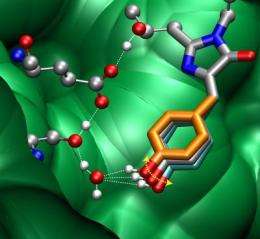
University of California, Berkeley, chemists have discovered the secret to the success of a jellyfish protein whose green glow has made it the darling of biologists and the subject of the 2008 Nobel Prize in Physiology or Medicine.
The researchers' study of green fluorescent protein (GFP) and the structural changes it undergoes when it fluoresces is the cover story of the Nov. 12 issue of the journal Nature.
GFP has replaced many dyes in biological studies because it is non-toxic and, when attached to a gene and inserted into an organism, serves as a bright, glowing confirmation that the gene has hit its target. Obtained originally from a bioluminescent Pacific Ocean jellyfish, the protein has been mutated and engineered to absorb and emit various colors.
The UC Berkeley chemists used extremely short laser pulses - 20 millionths of a nanosecond, or 20 femtoseconds - to take snapshots of GFP to determine the structural changes it undergoes when it fluoresces. Only a rapid, strobe-like laser can freeze atoms vibrating 100,000 times every nanosecond, or a hundred trillion times a second.
Their study not only sheds light on how GFP works, but also proves the value of new, ultrafast, pulsed laser techniques, specifically a method called femtosecond stimulated Raman spectroscopy, that take snapshots fast enough to freeze vibrating molecules and thereby distinguish the rapid steps involved in chemical and atomic reactions.
One of the researchers' goals is to understand the processes of absorption and emission of light in such detail that the light-absorbing molecule can be redesigned to more efficiently capture sunlight in photovoltaics, or solar cells.
"If you want to understand how a reaction occurs, you need to look at it as the chemical bonds change structure, which occurs over tens of femtoseconds," said Richard Mathies, UC Berkeley professor of chemistry and dean of the College of Chemistry. "With a femtosecond laser and Raman spectroscopy, we can see all the steps in the proton transfer reaction in the excited state of GFP."
The transfer of a positively-charged hydrogen atom - a bare proton - along a reaction chain in GFP generates a green flash of light. The laser snapshots show that when the light absorber, or chromophore, nestled in the middle of the protein barrel absorbs an incoming photon of blue light, it starts vibrating, and the electrons start sloshing around the chromophore until it is aligned just right for the proton to hop via a water molecule to a nearby amino acid in the protein. From there, it continues down the reaction chain, creating a state with a negatively charged chromophore that emits green light.
"A lot of people have studied green fluorescent protein for many years and found out that proton transfer in the excited state emits a very efficient flash - for every 100 blue photons going in, 80 green ones come out," said first author Chong Fang, a UC Berkeley postdoctoral fellow in the Department of Chemistry. "This experiment shows why it is so efficient with vivid atomistic details."
Previous studies had shown that after the chromophore absorbs blue light, it undergoes proton transfer, and green light is emitted. In the current study, Mathies, Fang and their colleagues could actually resolve the early stage of this proton transfer reaction, taking snapshots of the vibrational wagging of the chromophore skeleton in sync with the electron cloud in the chromophore sloshing back and forth. However, the wagging oscillation might have stopped after a few picoseconds, when the chromophore and its vicinity are aligned just right for the proton to hop off down the reaction chain, and the whole protein shines bright green - which it does in its own good time, in about 3 nanoseconds.
"We don't need the wagging oscillation to persist throughout the proton transfer process, we only need it to position the chromophore rings correctly relative to the rest of the reaction chain, and that initiates the processes leading to a flash of green light," Fang said.
In the past five years, Mathies and his colleagues have used femtosecond stimulated Raman spectroscopy to investigate similar atomic motions in large, light-absorbing molecules including rhodopsin, the visual pigment in the eye; bacteriorhodopsin, the light-capturing pigment in photosynthetic bacteria; and phytochrome, a light-sensing pigment found in plants and bacteria. This technique probes a range of vibrations - tens of femtoseconds to 1 picosecond (one-trillionth of a second) - that is important in chemical reactions, but until now largely inaccessible.
"This is something I've wanted to do for 40 years, ever since I came to Berkeley in 1976, but I didn't have the ability," Mathies said. "I had to develop the tools to get to tackle this challenging problem."
Femtosecond stimulated Raman spectroscopy on GFP involves hitting the protein molecule with an approximately 80 femtosecond pulse of ultraviolet light, which excites many vibrational modes in the molecule, and then a one-two punch of picosecond red and femtosecond white light to stimulate Raman emission. The spectrum of emitted signals tells researchers the vibrational modes of various parts of the molecule. If the molecule is in the middle of a reaction, the emitted light at different time delays tells the researcher the various steps the molecule goes through during the reaction.
"Now, we can get very, very high resolution structure down to 10-25 femtoseconds," Mathies said.
Mathies compares proton or electron transfer - the key event in absorption or emission of light - to a worker's trip from office to home, which can involve any number of routes. But previous techniques with mere picosecond resolution provided only a blurry picture, and often just the start and end points. With ultrafast femtosecond spectroscopy, he said, "you can see all the steps along the way, whether the worker goes down the stairs or out the window."
Source: University of California - Berkeley (news : web)


