What's in our water?
Nov 05, 2009
What's in our water?
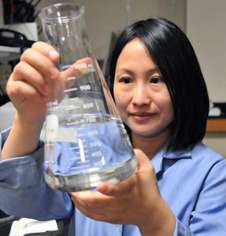
April Gu, assistant professor of civil and environmental engineering at Northeastern University, examines water in the lab. Photo by Craig Bailey

(PhysOrg.com) -- Although America's supply of drinking water is considered among the world's safest, there is an urgent need to develop more stringent regulations to guide how water is monitored for pollutants, according to April Gu, assistant professor of civil and environmental engineering at Northeastern University. Gu is working on the fundamental research underlying our ability to identify and monitor real and potential pollutants in water and remove them at lower cost than is now possible.

Funded by the National Science Foundation and the Environment Research Foundation, Gu and her colleagues hope to provide the necessary information to improve--both in cost and efficiency--how water treatment facilities remove pollutants from wastewater before it is released into the environment—our bays, harbors, rivers, and lakes.

Boston’s largest wastewater treatment facility, housed on Deer Island, treats 370 million gallons of sewage each day from 43 communities in Massachusetts. Gu is looking at how a treatment facility like this can improve current contaminant removal processes to make the water safer.

She is exploring a method to monitor how genes in bacteria are expressed when exposed to emerging contaminants, including nanomaterials and other toxic compounds that are products of new technology-driven industries. The data collected on the genetic reactions will provide fundamental toxicity data about the chemicals present in the water. This, said Gu, would provide a scientific basis on which to develop updated and accurate federal water regulations.

“Industrialization has led to a dramatic increase in the number of potential toxins in our water supply, yet we do not have sufficient monitoring systems in place that can detect them,” said Gu. “This sophisticated and reliable technique will help researchers evaluate and identify a greater number of potential contaminants, vastly improving our water assessment processes.”

Gu and her colleagues are also examining the impact of wastewater-derived organic nutrients on eutrophication, a process that leads to the overgrowth of nutrients in lakes, streams, rivers and other bodies of fresh water. The abundance of these nutrients, such as nitrogen and phosphorous, causes excessive growth of algae and other aquatic plants, which in turn causes fish and shellfish and other plant species to die from a lack of oxygen.

Eutrophication decreases the resource value of rivers, lakes and estuaries, and is still the leading cause of deterioration in our nation’s water supply, said Gu, whose research also focuses on improving ways to remove this form of pollution.

“We need to better monitor the water for pollutants, and most importantly, develop innovative and cost-effective ways to remove these pollutants to make drinking as safe as possible,” she said.

Provided by Northeastern University (news : web)

Explore further: Chinese, Indian airlines face EU pollution fines

add to favorites email to friend print save as pdf

Related Stories

Researchers find key to saving the world's lakes

Jul 21, 2008

After completing one of the longest running experiments ever done on a lake, researchers from the University of Alberta, University of Minnesota and the Freshwater Institute, contend that nitrogen control, in which the European ...

Too much nanotechnology may be killing beneficial bacteria

Apr 29, 2008

Too much of a good thing could be harmful to the environment. For years, scientists have known about silver’s ability to kill harmful bacteria and, recently, have used this knowledge to create consumer products containing ...

Early-Warning Water Security System to be Tested

Aug 25, 2006

Colorado State engineering researchers have begun testing an early-warning security system designed to alert city utility officials when major pollutants are detected in water supplies.

Recommended for you

Bold action, big money needed to curb Asia floods

3 hours ago

Asia's flood-prone megacities should fund major drainage, water recycling and waste reduction projects to stem deluges and secure clean supply for their booming populations, experts said Sunday.

Heat-related deaths in Manhattan projected to rise

4 hours ago

Residents of Manhattan will not just sweat harder from rising temperatures in the future, says a new study; many may die. Researchers say deaths linked to warming climate may rise some 20 percent by the 2020s, ...

Dire outlook despite global warming 'pause': study

4 hours ago

A global warming "pause" over the past decade may invalidate the harshest climate change predictions for the next 50 to 100 years, a study said Sunday—though levels remain in the danger zone.

Chinese, Indian airlines face EU pollution fines

May 18, 2013

Eight Chinese and two Indian airlines face fines of up to several million euros for not paying for their greenhouse gas emissions during flights within the bloc, the European Commission said on Friday.

User comments : 0

More news stories

Mice, gerbils perish in Russia space flight

A number of mice and eight gerbils sent into space in a Russian capsule destined to find out how well organisms can withstand extended flights perished during their journey, scientists said Sunday as the ...

Heat-related deaths in Manhattan projected to rise

Residents of Manhattan will not just sweat harder from rising temperatures in the future, says a new study; many may die. Researchers say deaths linked to warming climate may rise some 20 percent by the 2020s, ...

Honeybees trained in Croatia to find land mines

(AP)—Mirjana Filipovic is still haunted by the land mine blast that killed her boyfriend and blew off her left leg while on a fishing trip nearly a decade ago. It happened in a field that was supposedly ...

Kinks and curves at the nanoscale

One of the basic principles of nanotechnology is that when you make things extremely small—one nanometer is about five atoms wide, 100,000 times smaller than the diameter of a human hair—they are going ...