In Brief: Exploring the limits of antiferromagnetism in nanostructured materials
Oct 09, 2009
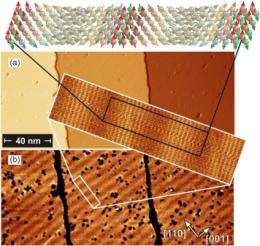
(Top) Schematic of the spin structure of the Mn monolayer on W(110) (6-nm repeat structure). (a) Topography and (b) differential conductance at 40 K. (Inset) High-resolution topographic data taken with a spin-sensitive tip; stripe contrast is related to the degree of antiferromagnetic order.

(PhysOrg.com) -- Researchers in the Electronic & Magnetic Materials & Devices Group (Argonne National Laboratory) and at Politecnico di Milano in Italy explored the limits of antiferromagnetism in a nanostructured material for the first time, measuring the temperature required to support antiferromagnetic order in atomic monolayers of manganese on tungsten as the dimensions of the structures are reduced.

While these boundaries are well understood in ferromagnetic materials, antiferromagnetic materials - where neighboring magnetic moments cancel rather than add together - have proven more challenging to unravel.

This study exploits the unique properties of manganese spin spirals on tungsten to correlate spin-sensitive scanning tunneling microscopy techniques on the atomic scale with electronic signatures, showing that the ordering temperature for the antiferromagnetic structure depends both on its size and its orientation with respect to the crystal lattice.

Such investigations will help guide the way to next generation platforms for ultra-high-density data storage and novel sensing capabilities.

More information: Paolo Sessi, Nathan P. Guisinger, Jeffrey R. Guest, and Matthias Bode, Phys. Rev. Lett. (in press)

Provided by Argonne National Laboratory (news : web)

Explore further: An environmentally friendly battery made from wood

add to favorites email to friend print save as pdf

Related Stories

Spintronic Materials Show Their First Move

Mar 23, 2005

How much energy does it take for an electron to hop from atom to atom, and how do the magnetic properties of the material influence the rate or ease of hopping? Answers to those questions could help explain why some materials, ...

Studying Magnetic Interface Ferromagnetism

Jun 28, 2007

The development of various magnetic-based devices, such as read-heads found inside your computer, depends on the discovery and improvement of new materials and magnetic effects.

Recommended for you

An environmentally friendly battery made from wood

1 hour ago

Taking inspiration from trees, scientists have developed a battery made from a sliver of wood coated with tin that shows promise for becoming a tiny, long-lasting, efficient and environmentally friendly energy ...

Sound waves precisely position nanowires

1 hour ago

(Phys.org) —The smaller components become, the more difficult it is to create patterns in an economical and reproducible way, according to an interdisciplinary team of Penn State researchers who, using ...

Hybrid nanostructures: Getting to the core

3 hours ago

Material scientists expect the new multifunctional properties of hybrid nanostructures will transform the development of high-performance devices, including batteries, high-sensitivity sensors and solar cells. ...

3D printing tiny batteries

20 hours ago

(Phys.org) —3D printing can now be used to print lithium-ion microbatteries the size of a grain of sand. The printed microbatteries could supply electricity to tiny devices in fields from medicine to communications, ...

World's most powerful microscope ready for research

Jun 18, 2013

(Phys.org) —The world's most powerful microscope, which resides in a specially constructed room at the University of Victoria, has now been fully assembled and tested, and has a lineup of scientists and businesses eager ...

User comments : 0

More news stories

Sound waves precisely position nanowires

(Phys.org) —The smaller components become, the more difficult it is to create patterns in an economical and reproducible way, according to an interdisciplinary team of Penn State researchers who, using ...

An environmentally friendly battery made from wood

Taking inspiration from trees, scientists have developed a battery made from a sliver of wood coated with tin that shows promise for becoming a tiny, long-lasting, efficient and environmentally friendly energy ...

3D printing tiny batteries

(Phys.org) —3D printing can now be used to print lithium-ion microbatteries the size of a grain of sand. The printed microbatteries could supply electricity to tiny devices in fields from medicine to communications, ...

Hybrid nanostructures: Getting to the core

Material scientists expect the new multifunctional properties of hybrid nanostructures will transform the development of high-performance devices, including batteries, high-sensitivity sensors and solar cells. ...

EUROnu project recommends building Neutrino Factory

(Phys.org) —The European Union's Seventh Framework Programme, EUROnu, has submitted its findings to a panel at CERN. Charged with choosing a project to study the nature of matter and antimatter, the project ...

'Ugly' finding: Unattractive workers suffer more

People who are considered unattractive are more likely to be belittled and bullied in the workplace, according to a first-of-its-kind study led by a Michigan State University business scholar.