Scientists obtain rocks moving into seismogenic zone
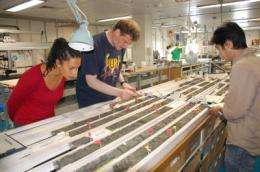
An international group of scientists aboard the Deep-Sea Drilling Vessel CHIKYU, operated by the Japan Agency for Marine-Earth Science and Technology (JAMSTEC) for the Integrated Ocean Drilling Program (IODP), return from a 40-day scientific expedition off the shore of the Kii Peninsula, Japan on Oct. 10, 2009. Expedition 322, called "Subduction Inputs" in the multi-stage project, conducted drilling, logging and sampling beneath the ocean floor to investigate input material that will be transported to the seismogenic zone by the plate subduction system.
The drilling operations were carried out at two sites in the Shikoku Basin, the back-arc basin of the Izu-Bonin volcanic chain where the Philippine Sea Plate dives down into the Nankai Trough at a rate of about 4 cm per year. At the first site C0011, scientists began coring from a depth of 340 meters below the seafloor. The coring, however, had to be abandoned at a depth of 881 meters because of damage of the drill bit. At the second site C0012, coring was carried out from depths 60 meters to 576 meters below the seafloor, and successfully collected the targeted sedimentary and basement rock samples.
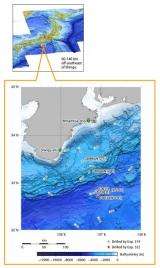
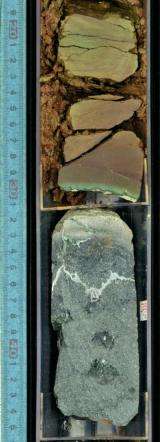
Dr. Michael Underwood, professor at University of Missouri, USA, and co-Chief Scientists of the expedition said, "We identified an interface of Miocene sediment and basement rock around 540 meters beneath the seafloor and successfully sampled basaltic pillow lava rocks that make up the basement." He added "These sedimentary and volcanic rocks in the lower part of Shikoku Basin are key intervals for generating large earthquake slip after they are transported to the seismogenic zone. Studying their petrological, geotechnical, frictional and hydrogeological properties prior to subduction is expected to contribute significantly to the understanding of rupture dynamics in the seismogenic zone."
The science party included 26 onboard research specialists from international member countries. "Scientists observed, measured and analyzed geological samples by day and night working shifts in the onboard laboratories," said Dr. Saneatsu Saito from JAMSTEC who led research activities as another co-Chief Scientist. He explained the importance of the variety of data obtained, "The sand-rich volcanic sediments were confirmed in large quantity and may have been transported from the easterly located Izu-Bonin Arc about 5 to 11 million years ago. Other sandstones contain abundant minerals derived from land, implying the extensive supply of sand to the Shikoku Basin from the Japanese islands." Prof. Underwood added, "Analysis of pore water and hydrocarbon gases retrieved from the sedimentary layers above the basement indicates multiple sources and migration paths of fluids. These results have important implications for understanding the properties of fluids within the seismogenic zone."
Source: Integrated Ocean Drilling Program Management International


