Plants' response to fire tested
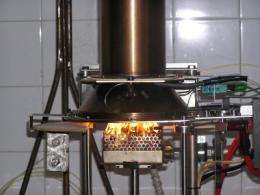
A team from the National Institute for Agricultural and Food Research and Technology (INIA) has developed a new method for identifying the flammability of plant species by using a device that measures how construction materials react to fire. The technique, which is being presented this week at the Fifth Spanish Forestry Congress, can be used to improve fire risk maps.
A group of researchers from the Forest Fires Laboratory (CIFOR-INIA) has applied a "mass loss calorimeter" - a device used to study how construction materials respond to fire - to forestry samples. "This allows us to study the flammability of plant species", Javier Madrigal Olmo, one of the study's authors, tells SINC.
The flammability trials measure the speed at which combustion starts and develops, as well as the amount of heat emitted by the sample during the process.
In order to measure these data, the researchers first put the plant sample in a special basket, "which is unique in the world", and which simulates natural conditions. The material heats up "constantly and uniformly" with a conical heater, and the gases rise up through a chimney, with a "thermopile" at the end, which registers the heat emitted.
"This methodology gives a very good reflection of how combustion takes place in conditions more like those found in the field, which is why we suggest it could be used to improve the classification systems (league tables, risk indices and flammability maps used in the Spanish autonomous regions), which to date have been based on tests that provide less information, or on those carried out in laboratory conditions far removed from reality", Madrigal tells SINC. "This would allow forestry managers to prioritize their preventive actions according to the tree species in the area".
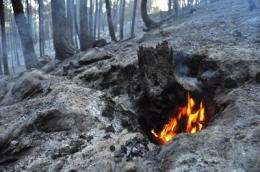
The creators of this technique, which is being presented in Ávila this Thursday at the Spanish Forestry Congress, have shown that flammability varies according to the humidity of the sample and the type of species. For example, it is higher for the Aleppo pine (Pinus halepensis) than the Maritime pine (Pinus pinaster), while the flammability of this species is higher still than that of the Kermes oak (Quercus coccifera).
Madrigal says that one of the investigation strands within climate change research focuses on how global temperature increase will affect plant physiology, "and this is influenced by factors such as humidity, and related to flammability".
The research has been published recently in the Journal of Fire Sciences and has been carried out as part of the EU's Sixth Framework Program FIRE PARADOX project, which is backing the development of new methods to prevent and extinguish forest fires using "innovative and integrated" approaches.
More information: J. Madrigal, C. Hernando, M. Guijarro, C. Díez, E. Marino, A.J. De Castro. "Evaluation of Forest Fuel Flammability and Combustion Properties with an Adapted Mass Loss Calorimeter Device". Journal of Fire Sciences 27 (4): 323-342, 2009
Source: FECYT - Spanish Foundation for Science and Technology


