Paper battery may power electronics in clothing and packaging material
Sep 23, 2009
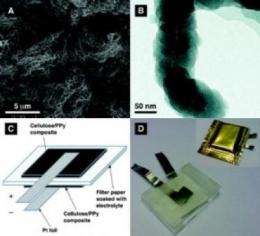
Batteries made of paper may power electronics in the future, researchers say. Shown are images from an experimental paper-based battery. Credit: The American Chemical Society

Imagine a gift wrapped in paper you really do treasure and want to carefully fold and save. That's because the wrapping paper lights up with words like "Happy Birthday" or "Happy Holidays," thanks to a built in battery -- an amazing battery made out of paper. That's one potential application of a new battery made of cellulose, the stuff of paper, being described in the October 14 issue of ACS' Nano Letters.

Albert Mihranyan and colleagues note in the report that scientists are trying to develop light, ecofriendly, inexpensive batteries consisting entirely of nonmetal parts. The most promising materials include so-called conductive polymers or "plastic electronics."

One conductive polymer, polypyrrole (PPy), shows promise, but was often regarded as too inefficient for commercial batteries. The scientists realized, however, that by coating PPy on a large surface area substrate and carefully tailoring the thickness of the PPy coating, both the charging capacity and the charging (discharging) rates can be drastically improved.

The secret behind the performance of this battery is the presence of the homogeneous, uninterrupted, nano-thin coating — about 1/50,000th the thickness of a human hair — of PPy on individual cellulose fibers which in turn can be molded into paper sheets of exceptionally high internal porosity. It was special cellulose, extracted from a certain species of , with 100 times the surface area of cellulose found in paper. That surface area was key to allowing the new device to hold and discharge electricity very efficiently.

The innovative design of the was surprisingly simple yet very elegant since both of the electrodes consist of identical pieces of the composite paper separated by an ordinary filter paper soaked with serving as the . The potential difference is solely due to differences between the oxidized and reduced forms of the functional PPy layer. The recharged faster than conventional rechargeable batteries and appears well-suited for applications involving flexible electronics, such as clothing and packaging, the scientists say. Alternatively, low-cost very large energy storage devices having electrodes of several square yards in size could potentially be made in the future.

More information: "Ultrafast All-Polymer Paper-Based Batteries", . DOI: 10.1021/nl901852h

Source: American Chemical Society (news : web)

Explore further: Hybrid material as gold-leaf substitute

add to favorites email to friend print save as pdf

Related Stories

Battery Wrapped in Solar Cells Recharges in the Sun

Mar 02, 2009

(PhysOrg.com) -- Although you can buy solar charging devices for rechargeable batteries, it would be even more convenient if batteries had built-in solar cells. Sitting in sunlight, the battery could then ...

Flexible battery power

Mar 19, 2007

A paper-like, polymer based rechargeable battery has been made by Japanese scientists. The news is reported in the latest edition of The Royal Society of Chemistry journal Chemical Communications.

Brown engineers build a better battery -- with plastic

Sep 13, 2006

Brown University engineers have created a new battery that uses plastic, not metal, to conduct electrical current. The hybrid device marries the power of a capacitor with the storage capacity of a battery. ...

Recommended for you

Hybrid material as gold-leaf substitute

18 hours ago

(Phys.org) —A team of researchers headed by Professor Raffaele Mezzenga has created a hybrid material out of gold and milk proteins that looks like a wafer-thin gold leaf. Thanks to its properties, it could ...

Antioxidant with a long shelf life

Jun 17, 2013

(Phys.org) —Scientists from ETH Zurich have developed a nanomaterial that protects other molecules from oxidation. Unlike many such active substances in the past, the ETH-Zurich researchers' antioxidant ...

Fast pollutant degradation by nanosheets

Jun 17, 2013

(Phys.org) —Waste from textile and paint industries often contains organic dyes such as methylene blue as pollutants. Photocatalysis is an efficient means of reducing such pollution, and molybdenum trioxide ...

Unzipped nanotubes unlock potential for batteries

Jun 13, 2013

(Phys.org) —Researchers at Rice University have come up with a new way to boost the efficiency of the ubiquitous lithium ion (LI) battery by employing ribbons of graphene that start as carbon nanotubes.

Nanoparticle opens the door to clean-energy alternatives

Jun 13, 2013

(Phys.org) —Cheaper clean-energy technologies could be made possible thanks to a new discovery. Research team members led by Raymond Schaak, a professor of chemistry at Penn State University, have found ...

User comments : 0

More news stories

3D printing tiny batteries

(Phys.org) —3D printing can now be used to print lithium-ion microbatteries the size of a grain of sand. The printed microbatteries could supply electricity to tiny devices in fields from medicine to communications, ...

Future looks bright for carbon nanotube solar cells

(Phys.org) —In an approach that could challenge silicon as the predominant photovoltaic cell material, University of Wisconsin-Madison materials engineers have developed an inexpensive solar cell that exploits ...

Hybrid material as gold-leaf substitute

(Phys.org) —A team of researchers headed by Professor Raffaele Mezzenga has created a hybrid material out of gold and milk proteins that looks like a wafer-thin gold leaf. Thanks to its properties, it could ...

World's most powerful microscope ready for research

(Phys.org) —The world's most powerful microscope, which resides in a specially constructed room at the University of Victoria, has now been fully assembled and tested, and has a lineup of scientists and businesses eager ...

Origins of 'The Hoff' crab revealed (w/ Video)

The history of a new type of crab, nicknamed 'The Hoff' because of its hairy chest, which lives around hydrothermal vents deep beneath the Southern Ocean and Indian Ocean, has been revealed for the first ...