New Vista of Milky Way Center Unveiled
Sep 22, 2009
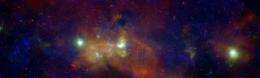
This X-ray panorama of the Milky Way's center reveals thousands of point-like sources, mysterious filaments, and a diffuse haze, all in X-ray light and extends some 900 light years across. Because X-rays penetrate the gas and dust that blocks optical light coming from the center of the galaxy, Chandra is a powerful tool for studying the Galactic Center. This image combines low-energy (red), intermediate energy X-rays (green) and high-energy X-rays (blue) that Chandra can detect. Credit: NASA/CXC/UMass/D. Wang

(PhysOrg.com) -- A dramatic new vista of the center of the Milky Way galaxy from NASA's Chandra X-ray Observatory exposes new levels of the complexity and intrigue in the Galactic center. The mosaic of 88 Chandra pointings represents a freeze-frame of the spectacle of stellar evolution, from bright young stars to black holes, in a crowded, hostile environment dominated by a central, supermassive black hole.

Permeating the region is a diffuse haze of X-ray light from gas that has been heated to millions of degrees by winds from massive young stars - which appear to form more frequently here than elsewhere in the Galaxy - explosions of dying stars, and outflows powered by the supermassive black hole - known as Sagittarius A* (Sgr A*). Data from Chandra and other X-ray telescopes suggest that giant X-ray flares from this black hole occurred about 50 and about 300 years earlier.

The area around Sgr A* also contains several mysterious X-ray filaments. Some of these likely represent huge magnetic structures interacting with streams of very energetic electrons produced by rapidly spinning neutron stars or perhaps by a gigantic analog of a solar flare.

Scattered throughout the region are thousands of point-like X-ray sources. These are produced by normal stars feeding material onto the compact, dense remains of stars that have reached the end of their evolutionary trail - white dwarfs, and .

Because X-rays penetrate the gas and dust that blocks optical light coming from the center of the galaxy, Chandra is a powerful tool for studying the Galactic Center. This image combines low energy X-rays (colored red), intermediate energy X-rays (green) and high energy X-rays (blue).

The image is being released at the beginning of the "Chandra's First Decade of Discovery" symposium being held in Boston, Mass. This four-day conference will celebrate the great science Chandra has uncovered in its first ten years of operations. To help commemorate this event, several of the astronauts who were onboard the Space Shuttle Columbia - including Commander Eileen Collins -- that launched Chandra on July 23, 1999, will be in attendance.

Source: Chandra X-ray Center (news : web)

Explore further: Subaru Telescope observations and CoRoT mission unveil future of the Sun

add to favorites email to friend print save as pdf

Related Stories

Chandra Lifts the Veil on Milky Way 'Hotspot'

Jan 23, 2008

NASA's Chandra X-ray Observatory is helping to demystify Westerlund 2, a young star cluster with an estimated age of about one- or two-million years. Heavily obscured by dust and gas, Westerlund 2 has been ...

Peering into the Pillars of Creation

Feb 15, 2007

A new look at the famous "Pillars of Creation" with NASA’s Chandra X-ray Observatory has allowed astronomers to peer inside the dark columns of gas and dust. This penetrating view of the central region of ...

Resolving a galactic mystery

Apr 29, 2009

An extremely deep Chandra X-ray Observatory image of a region near the center of our Galaxy has resolved a long-standing mystery about an X-ray glow along the plane of the Galaxy. The glow in the region covered ...

Dark energy, black holes and exploding stars

Aug 12, 2004

On Aug. 12, 1999, NASA's Chandra X-ray Observatory opened its sunshade doors for the first time, allowing celestial X-ray light to reach the observatory's mirrors. This one small step for the observatory pro ...

Chandra finds black holes are 'green'

Apr 24, 2006

Black holes are the most fuel efficient engines in the Universe, according to a new study using NASA's Chandra X-ray Observatory. By making the first direct estimate of how efficient or "green" black holes ...

Recommended for you

Galaxy's Ring of Fire

May 18, 2013

Johnny Cash may have preferred this galaxy's burning ring of fire to the one he sang about falling into in his popular song. The "starburst ring" seen at center in red and yellow hues is not the product of ...

4C+29.30: Black hole powered jets plow into galaxy

May 15, 2013

(Phys.org) —This composite image of a galaxy illustrates how the intense gravity of a supermassive black hole can be tapped to generate immense power. The image contains X-ray data from NASA's Chandra X-ray ...

User comments : 1

Adjust slider to filter visible comments by rank

Display comments: newest first

omatumr
2 / 5 (4) Sep 22, 2009
Thousands of Point-Like Sources at the . . .

. . . Center of the Milky Way provide visual confirmation of repulsive interactions between neutrons ["Neutron repulsion confirmed as energy source", Journal of Fusion Energy 20 (2003) 197-201].

With kind regards,
Oliver K. Manuel

More news stories

Unraveling the Napo's mystery

In the United States, rivers and their floodplains are well-documented and monitored. Ecuador's largest river, however, remains largely mysterious. Research led by Michigan State University is helping the ...

Slow earthquakes: It's all in the rock mechanics

(Phys.org) —Earthquakes that last minutes rather than seconds are a relatively recent discovery, according to an international team of seismologists. Researchers have been aware of these slow earthquakes, ...

Hong Kong launches plan to tackle waste crisis

Hong Kong on Monday launched a ten-year plan to reduce waste by 40 percent per person as part of efforts to catch up with other leading Asian cities and avert a looming environmental crisis.

Study shows how bilinguals switch between languages

(Medical Xpress)—Individuals who learn two languages at an early age seem to switch back and forth between separate "sound systems" for each language, according to new research conducted at the University of Arizona.

Non-wetting fabric drains sweat

(Phys.org) —Waterproof fabrics that whisk away sweat could be the latest application of microfluidic technology developed by bioengineers at the University of California, Davis.

Lab sets a new record for creating heralded photons

(Phys.org) —Entanglement, by general consensus of physicists, is the weirdest part of quantum science. To say that two particles, A and B, are entangled means that they are actually two parts of an inseparable ...