From Chicken Feathers to Flower Pots
Sep 09, 2009 By Sharon Durham
From Chicken Feathers to Flower Pots
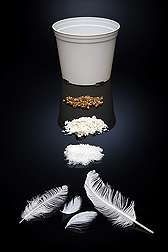
ARS researchers have developed a way to turn chicken feathers, usually an unwanted byproduct of poultry processing, into a valuable ingredient in biodegradable flower pots—an all around plus for the environment. Click the image for more information about it.

Chicken feathers, usually an unwanted byproduct of poultry processing, may have a more valuable future as an ingredient in biodegradable flower pots, according to an Agricultural Research Service (ARS) scientist.

Chemist Walter Schmidt, in the ARS Environmental Management and Byproduct Utilization Laboratory in Beltsville, Md., has been developing practical uses for discarded chicken feathers. Each year, approximately 4 billion pounds of are left over after processing in the United States.

Working with the Horticultural Research Institute (HRI) in Washington, DC, Schmidt and HRI research associate Masud Huda have formulated planting pots that degrade over variable periods of time, ranging from one to five years.

The pots look and feel like any other planters encountered at your local nursery, but they are made to disintegrate naturally, without harm to the environment. In fact, the pots -- manufactured without any petroleum components -- would slowly release beneficial nitrogen to the soil.

In 2002, Schmidt and Justin Barone, a former ARS research associate, found feather-derived plastic could be molded just like any other plastic and has properties very similar to plastics such as polyethylene and polypropylene. This makes the feather-derived plastic a unique material for packaging or any other application where high strength and biodegradability are desired, according to Schmidt. In 2006, the process of making composites and films from feather keratin was patented by ARS.

Schmidt and Huda are now working to develop fully biodegradable flowerpots. Several commercial pot manufacturers are involved in this phase to determine optimum production-scale molding specifications for the containers. According to Schmidt, the "green" horticultural end products will not only help solve the environmental problem by creating , but will also provide a cost-effective commercial use for feathers.

Provided by Agricultural Research Service

Explore further: Method developed for adding omega-3 fatty acids to foods

add to favorites email to friend print save as pdf

Related Stories

Feather scientists have Christmas all wrapped up

Dec 22, 2008

(PhysOrg.com) -- Material scientists at The University of Manchester are causing a festive flap after developing a way of making Christmas wrapping paper – from TURKEY FEATHERS.

Of Rice and Hen: Fashions from the Farm

Sep 12, 2006

In the future, it might be perfectly normal to wear suits and dresses made of chicken feathers or rice straw. But don’t worry: These clothes won’t resemble fluffy plumage or hairy door mats. Scientists ...

Recycling Food Scraps into Gardens

Sep 07, 2009

Each weekday, food scraps are collected from the Maryland Food Distribution Authority in Jessup, Md., and from small local food service and marketing establishments. Materials that do not contain metal, glass, ...

Recommended for you

Attacking MRSA with metals from antibacterial clays

May 17, 2013

In the race to protect society from infectious microbes, the bugs are outrunning us. The need for new therapeutic agents is acute, given the emergence of novel pathogens as well as old foes bearing heightened antibiotic resistance.

Beautiful 'flowers' self-assemble in a beaker

May 16, 2013

By simply manipulating chemical gradients in a beaker of fluid, materials scientists at Harvard have found that they can control the growth behavior of crystals to create precisely tailored structures—such ...

Reading the unreadable

May 16, 2013

Pioneering X-ray technology is making it possible to read fragile rolled-up historical documents for the first time in centuries.

Keeping fruit, vegetables and cut flowers fresh longer

May 15, 2013

New technology offers the promise of reducing billions of dollars of losses that occur each year from the silent, invisible killer of fruits, vegetables and cut flowers—a gas whose effects are familiar to everyone who has ...

User comments : 0

More news stories

Attacking MRSA with metals from antibacterial clays

In the race to protect society from infectious microbes, the bugs are outrunning us. The need for new therapeutic agents is acute, given the emergence of novel pathogens as well as old foes bearing heightened antibiotic resistance.

Beautiful 'flowers' self-assemble in a beaker

By simply manipulating chemical gradients in a beaker of fluid, materials scientists at Harvard have found that they can control the growth behavior of crystals to create precisely tailored structures—such ...

Making gold green: New non-toxic method for mining gold

Northwestern University scientists have struck gold in the laboratory. They have discovered an inexpensive and environmentally benign method that uses simple cornstarch—instead of cyanide—to isolate gold from raw materials ...

Morocco to harness the wind in energy hunt

Morocco is ploughing ahead with a programme to boost wind energy production, particularly in the southern Tarfaya region, where Africa's largest wind farm is set to open in 2014.

Galaxy's Ring of Fire

Johnny Cash may have preferred this galaxy's burning ring of fire to the one he sang about falling into in his popular song. The "starburst ring" seen at center in red and yellow hues is not the product of ...